· 12 min read
Sergii

Every civilization begins with its first settlers.

Three months ago, War of Continents opened its gates to its very first settlers.

At that moment, the world consisted of little more than ideas brought to life: a handful of lands, a few heroes, and the hope that players would find meaning in building something that could persist for years rather than weeks.

No amount of internal testing could answer the questions that truly mattered.

  • Would players understand the world?

  • Would the economy feel alive?

  • Would the progression systems remain engaging?

  • Would the vision of a persistent civilization prove strong enough to survive its first encounters with reality?

Since launch, those questions have gradually found their answers. The world has grown. Players have left their mark. Systems have evolved. Ideas have been challenged, refined, and sometimes completely reimagined. Some mechanics exceeded expectations. Others revealed weaknesses that only real players could uncover.


This article is not a changelog.

It is a snapshot of the world's first chapter — the people who shaped it, the lessons learned, the milestones reached, and the foundations laid for everything that will follow.

Because one day, years from now, today's thriving civilizations may look back at these first months and remember how small the continent once was.

The World Comes Alive

A persistent world does not become alive because it has maps, heroes, or mechanics. It becomes alive when real people begin living inside it.

Every new settlement, every completed mission, every discovered Elemental and every earned achievement gradually transformed an empty continent into a living civilization.

The First Settlers
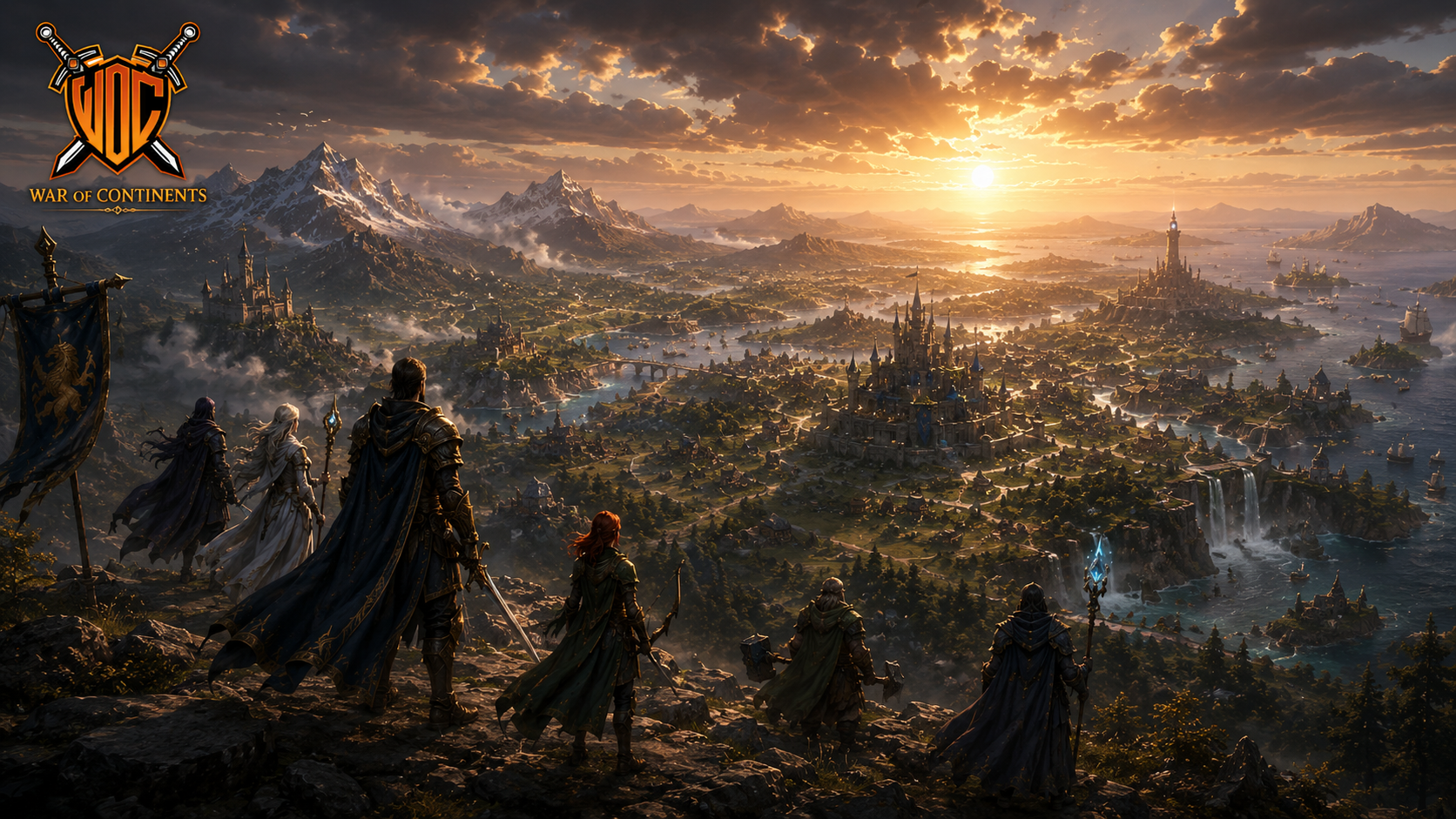
New settlers.

War of Continents did not begin with thousands of anonymous accounts.

It began with a small group of early settlers who entered the world while many of its foundations were still being tested, questioned and improved.

During the first three months, 33 players registered in the world, and 17 of them became active participants in its early history.

These numbers also reflect an important part of the world's early evolution.

Many of the first registrations happened before Frontier existed, when entering the game required a much higher level of commitment and NFT assets were the main way to begin playing.

Some players reached the gates of the world before the world had learned how to properly welcome them.

That lesson directly shaped the future of onboarding.

Today, new settlers can start with Frontier Land and Heroes, explore the core gameplay for free, and decide later whether they want to use blockchain ownership features.

StatisticValue
Registered Settlers33
Active Settlers17

The First Civilizations

The first settlers did not enter an empty interface.

They entered a world built around Lands and Heroes — the two foundations from which every civilization begins.

A Land is more than a place on a map. It is the center of future growth: a source of Gold, Elementals, buildings, storage, missions and long-term development.

A Hero is more than a unit. Each Hero becomes the active hand of a settlement: travelling between Lands, completing missions, gathering resources, hunting Seals and carrying the progress of the player forward.

During the first three months, 56 Lands and 174 Heroes appeared in the world.

Not all of them became active immediately. A meaningful part of these early assets belonged to players who registered before Frontier became the main entry path into the game — before new settlers could easily begin with free Lands and Heroes.

But among those who did enter the world fully, the continent became visibly alive.

36 Lands became active centers of civilization.

120 Heroes took part in the early movement of the world.

StatisticValue
Lands created56
Active Lands36
Heroes created174
Active Heroes120

A World In Motion

The strongest sign of life was not the number of registered accounts. It was movement.

During the first three months, Heroes were sent on missions again and again. Lands produced Gold. Elementals were discovered, carried, stored and used for construction. Seals were hunted, and experience accumulated across Profiles and Heroes, turning daily actions into long-term progress.

By the end of this period, the continent had recorded tens of thousands of completed actions across its economy and progression systems. The world was still young, but it was no longer still.

Activity MetricValue
Missions Completed23 702
Gold Claimed168 392
Gold Spent158 194
Elementals Gathered468 417
Experience Earned6 179 570
Seals Found472

Stable Foundations

One of the project's goals from the very beginning was to build a persistent world capable of running continuously.

During its first three months, the live server completed thousands and thousands missions while experiencing only two minor service incidents.

Only 12 missions were lost because of technical problems across the entire period.

For a young persistent world, this mattered. The continent was not only growing, changing and learning — it was able to remain stable while doing so.

The numbers themselves are not the story.

They simply point to something much more important: the continent is no longer empty.

It already has settlements, an economy, achievements and the first traces of its own history.

Most importantly, it has people who entered the world, shaped its earliest days and turned War of Continents from a project into a living place.

A World That Learned

One of the biggest discoveries during the first three months was that a persistent world is never truly finished.

No amount of internal testing can replace real players exploring the world in unexpected ways. Some mechanics proved stronger than expected, while others revealed opportunities for improvement that only became visible after hundreds of completed missions and countless discussions with the first settlers.

As the world grew, so did its understanding of what War of Continents should become.

Frontier Evolution
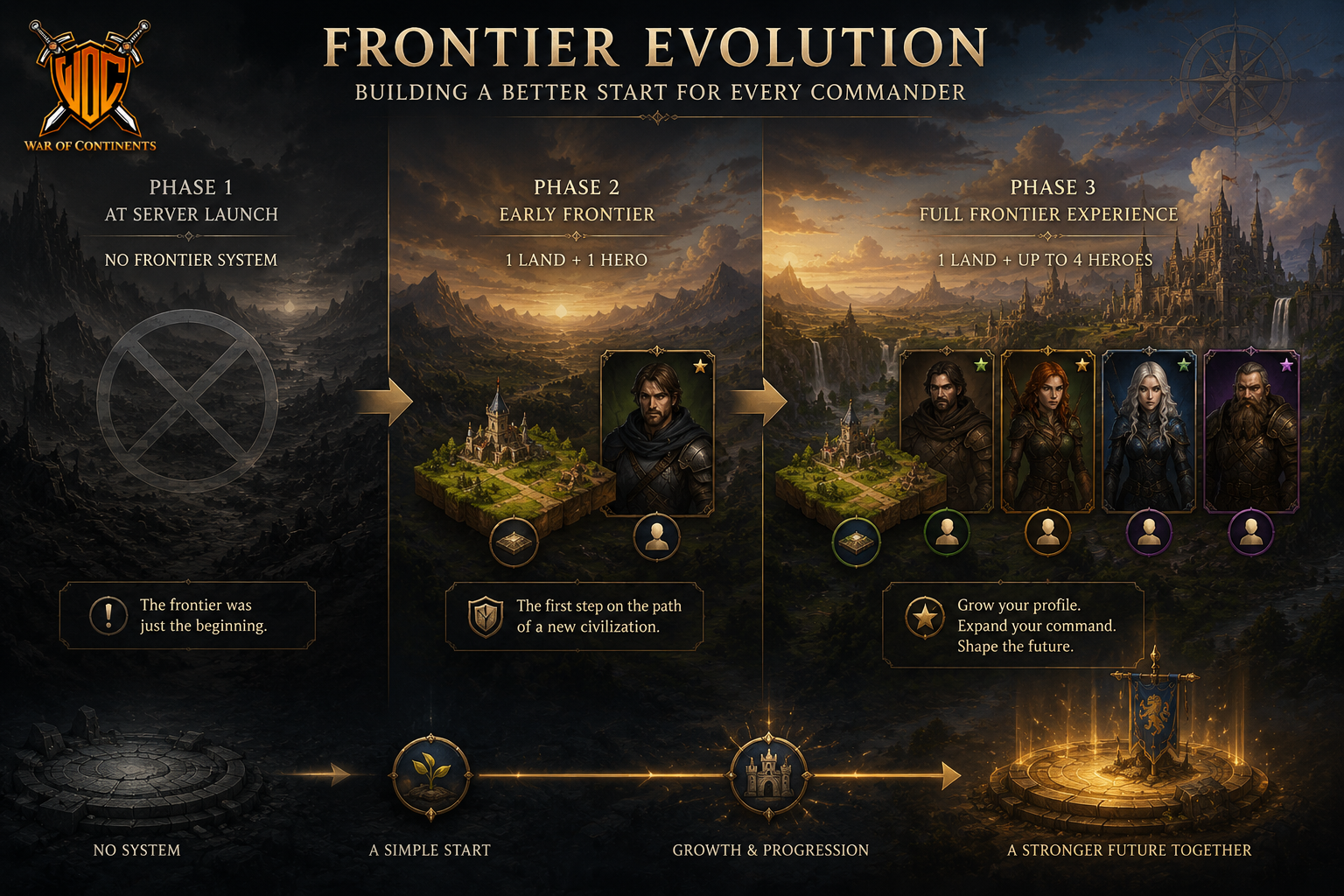
Frontier Evolution.

The journey of new players changed dramatically during these first months.

At launch, War of Continents offered no free way to experience the world. Participation began with NFT assets, making the barrier to entry higher than originally anticipated.

The first version of Frontier introduced a free Land and Hero for players who connected their X account. It allowed newcomers to explore the world, but it quickly became clear that a single Hero was not enough to experience the strategic rhythm of the game.

Frontier continued to evolve.

Today every new settler receives:

  • one Frontier Land;
  • two Frontier Heroes immediately;
  • a third Hero upon reaching Profile Level 1;
  • a fourth Hero upon reaching Profile Level 2.

Frontier gradually stopped being a way to try the game. It became a genuine way to begin building a civilization.

A Simpler Beginning
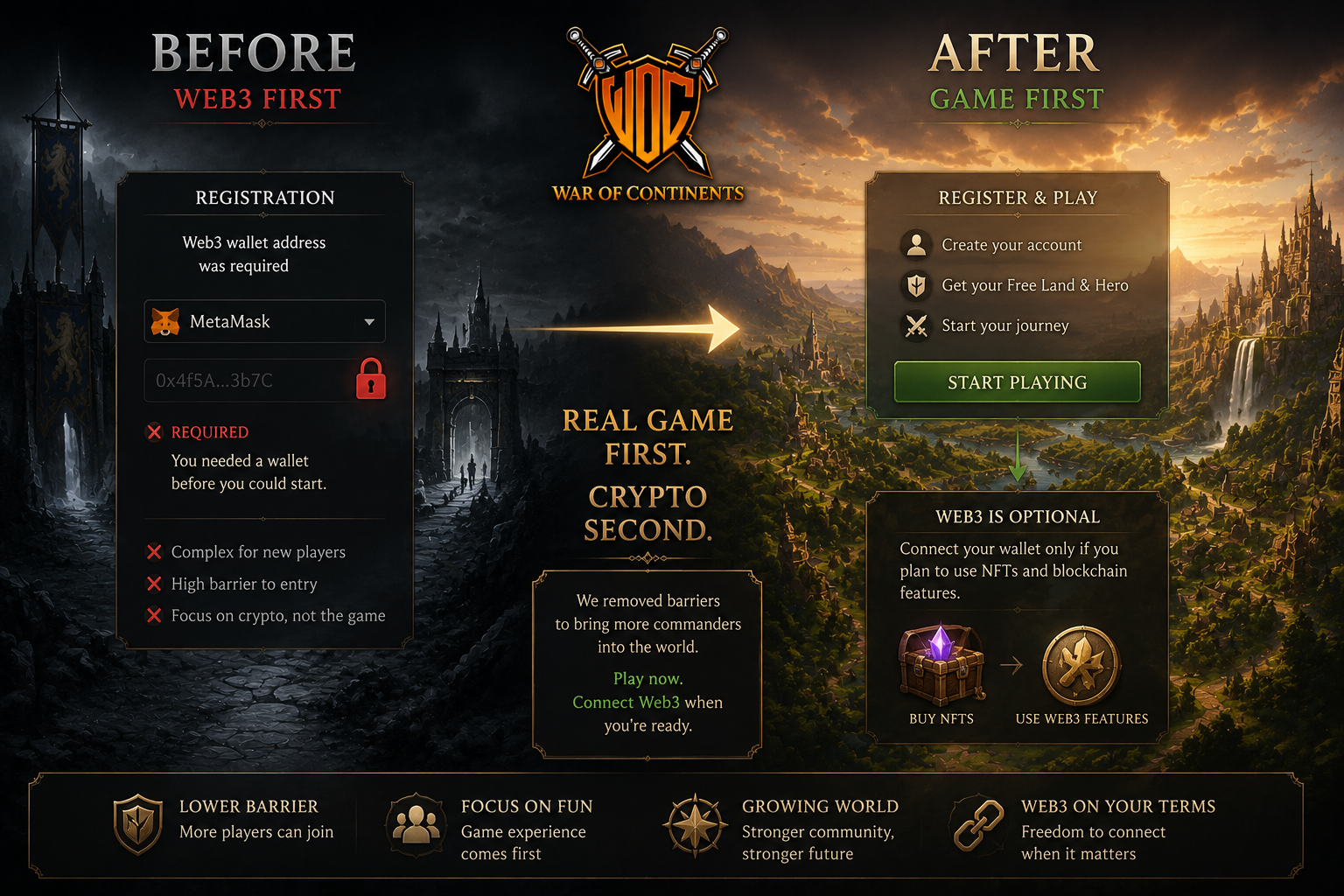
Play first. Connect later.

Another important lesson concerned the very first minutes inside the game.

Originally, connecting a MetaMask wallet was a mandatory part of registration. While technically reasonable, it introduced complexity before players had the opportunity to discover whether they even enjoyed the world itself.

That approach has now been completely reversed.

Today anyone can create an account, receive Frontier assets, and begin playing immediately without any blockchain knowledge or wallet connection.

MetaMask remains available for players who later decide to use NFT ownership and blockchain features, but it no longer stands between a new player and the beginning of their journey.

The philosophy became simple:

Play first. Connect later.

A More Coherent Civilization
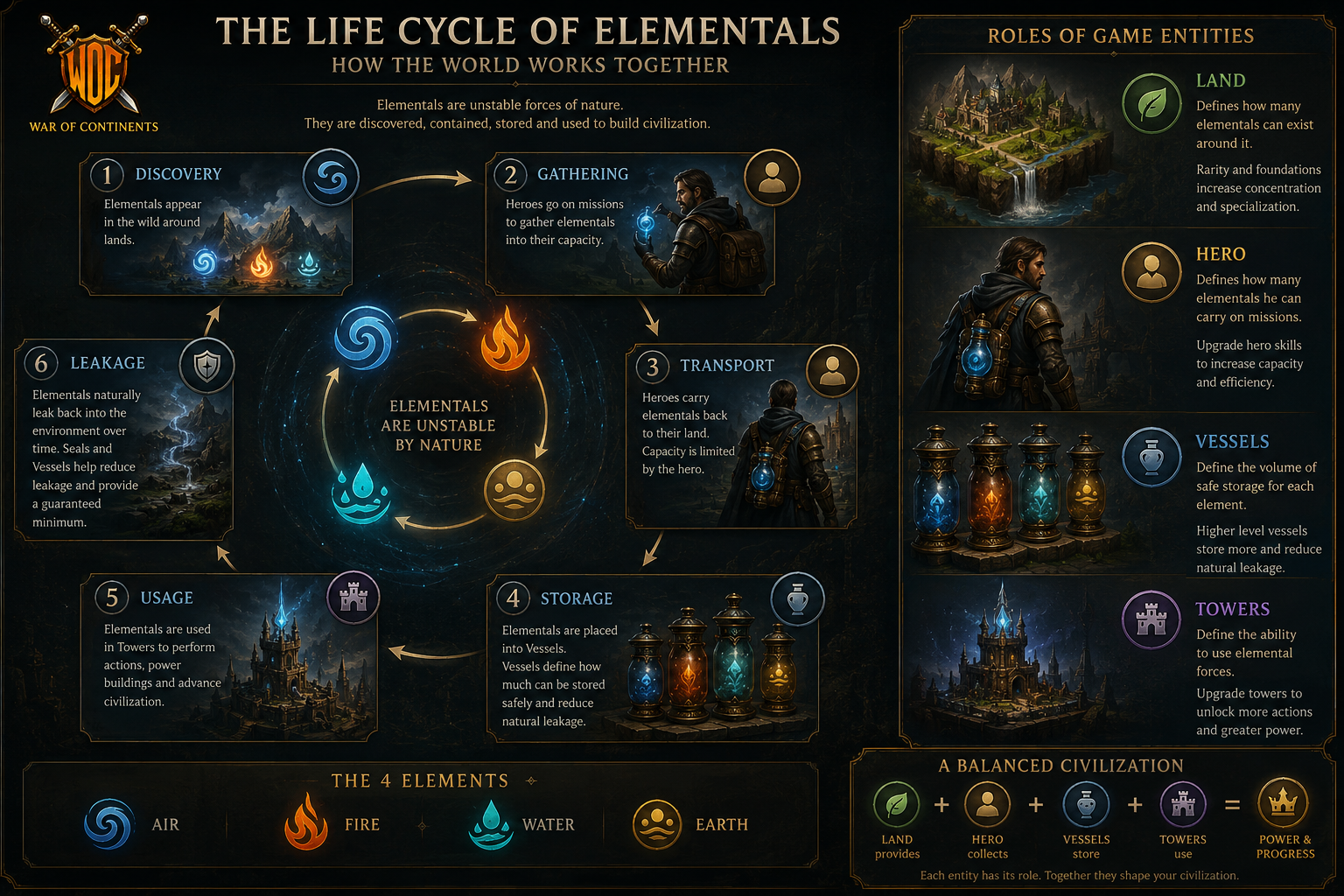
Elemental Vessels.

The most significant redesign during these three months took place much deeper inside the world's mechanics.

The original implementation relied heavily on Profile Level to determine many aspects of elemental gameplay. While this simplified the initial release, it gradually became clear that the world itself should define how elemental energy behaves.

The redesign followed one simple principle: every entity in the world should be responsible only for what naturally belongs to it.

Today:

  • Lands determine where and how Elementals are discovered.
  • Heroes determine how much elemental energy they can transport.
  • Elemental Vessels determine how much elemental energy a settlement can safely contain.
  • Towers transform that stored energy into long-term civilization growth.

The introduction of Elemental Vessels fundamentally changed settlement progression.

Construction is no longer limited only by discovering Elementals. Civilizations must first develop the infrastructure capable of containing and stabilizing elemental energy before it can be transformed into lasting progress.

The result is a world where every major system has its own clear responsibility, making progression feel more natural, more strategic, and far more coherent than during the earliest weeks after launch.

Built Together With Players
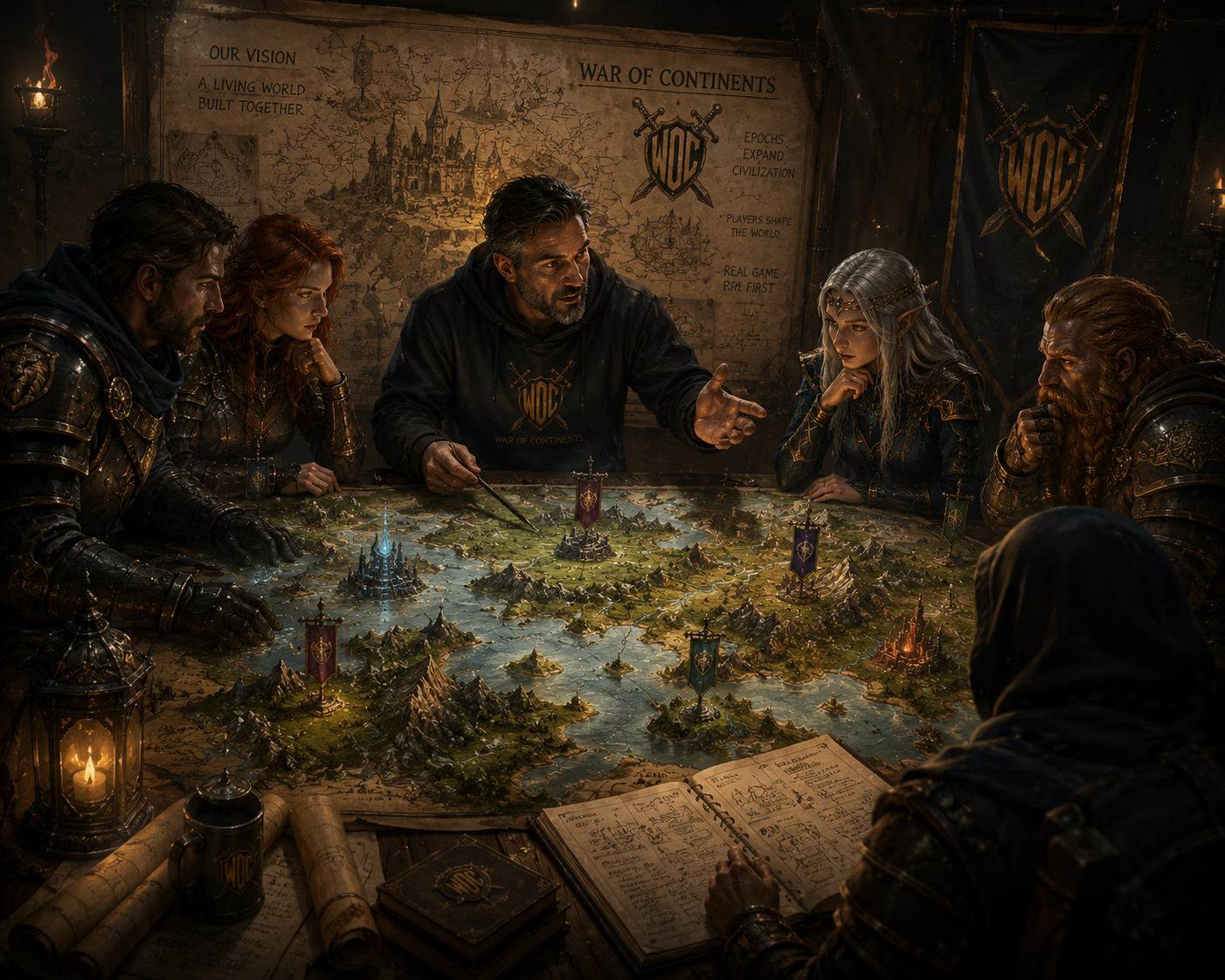
Built Together With Players.

Perhaps the most important lesson of the first chapter was that War of Continents could not be shaped in isolation.

Many of the changes described above began with real players: their questions, suggestions, debates, bug reports and unexpected ways of interacting with the world.

The first settlers did more than complete missions or climb rankings. They tested the foundations of the world while those foundations were still young. Some helped reveal weaknesses. Some suggested better paths forward. Some simply kept playing, returning day after day, proving which systems had enough depth to matter.

Because of them, the world that welcomes new settlers today is richer, clearer and more forgiving than the one that opened its gates three months ago.

They did not only play the first version of War of Continents. They helped build the next one. That is what Play2Build means in practice.

The First Names in History

A persistent world is shaped not only by systems and statistics.

It is shaped by the people who are the first to cross its boundaries, test its limits, and achieve things that no one before them has accomplished.

During the first three months, several settlers began writing their names into the earliest history of War of Continents.
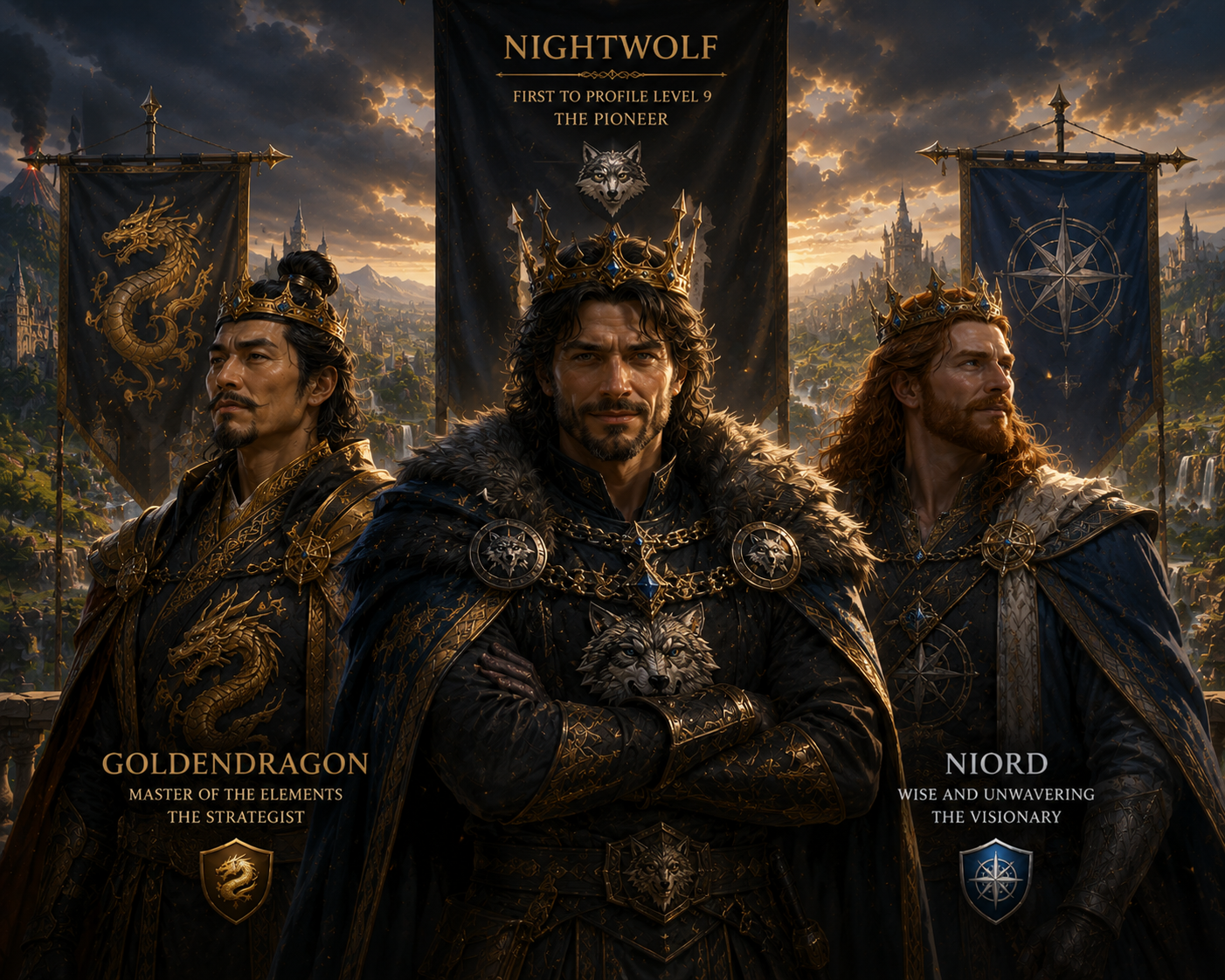
First Names.

NightWolf

NightWolf became one of the defining settlers of the first months.

  • first player to reach Profile Level 9;
  • first to upgrade all four Elemental Towers on one Land to Level 4;
  • later the first to bring all four Towers to Level 5;
  • repeated appearances among the weekly leaders;
  • one of the most consistent competitors across multiple rankings.

His progress became one of the clearest examples of how far a dedicated player could advance during the world's earliest stage.

Niord

Niord became one of NightWolf's closest competitors and reached Profile Level 9 only one day later.

  • second player to reach Profile Level 9;
  • regular leader in Seal Hunting;
  • strong results in missions, experience and resource gathering;
  • one of the most active participants in the early competition between settlers.

His progress helped turn individual achievements into a real race between the first leaders of the world.

GoldDragon

GoldDragon established a reputation through consistent activity and strong performance across the economy of the world.

  • leading positions among Elemental Gatherers;
  • strong results in completed missions;
  • regular presence near the top of weekly rankings;
  • one of the most recognizable names of the first months.

GoldDragon's progress demonstrated the importance of sustained activity and balanced development.

More Than Three Names

The earliest history of War of Continents belongs to more than its leading players.

Settlers such as El Pidoro, jaws1977, Barwar, Udaff4eg, SilkWing, Sir C Maker and others also contributed through missions, discoveries, testing, discussions and feedback.

Their efforts helped move the world forward at a time when it was still fragile, incomplete and learning from every real interaction.

Not every contribution appears at the top of a leaderboard.

Some players helped uncover problems.

Some suggested improvements.

Some simply returned every day and kept the world moving.

Together, they became the first community of War of Continents.

Looking Beyond the Horizon
The journey has only just begun.

Three months is a very small chapter in the life of a persistent world.

The first settlements have been founded, the first heroes have earned their place in history, the first rivalries have emerged, and the first lessons have already reshaped the world.

Yet everything described in this article is only the beginning.

The continents remain largely unexplored. Many mechanics still await future epochs. Wars have yet to be fought. Great alliances have yet to rise. Entire civilizations have yet to leave their mark on history.

War of Continents was never designed to be completed within weeks or even months.

It was built with a different ambition: to become a world capable of growing for years, shaped not only by its developer, but by every player who chooses to become part of its history.

Perhaps, years from now, someone will rediscover this article and smile at how small the world once was.

Only a handful of settlers.

Only a few dozen lands.

Only the first names carved into the chronicles.

Every great civilization begins somewhere.

These were the first three months.

The journey has only just begun.
· 3 min read
Sergii

Frontier has evolved.

What began as a small gateway into War of Continents has now become a much stronger free start for new settlers. The goal is simple: a player should be able to enter the world, understand the core loop, grow a profile, and make meaningful progress before deciding whether to expand into NFT ownership.

Frontier Settlement

A Real Free Start

With the new Frontier system, registration now grants every new player:

  • 1 Frontier Land
  • 2 Frontier Heroes

That is enough to begin playing the real game: launching missions, collecting resources, gaining experience, and learning how Lands and Heroes work together.

This is not a separate demo mode. Frontier assets are active in-game assets. They let new players participate in the living world of WOC immediately, without buying Platinum or minting NFTs first.

More Heroes Through Progression

Frontier also grows with the player.

When a profile reaches early milestones, the roster expands:

  • Profile Level 1 grants +1 Frontier Hero
  • Profile Level 2 grants +1 Frontier Hero

This means a new player can progress from registration to 1 Frontier Land and up to 4 Frontier Heroes through free gameplay.

That matters because Heroes are the engine of the game. More Heroes means more missions, more choices, more resource flow, and a better sense of the strategic rhythm of War of Continents.

Why This Changes The Entry Experience

Earlier, starting a strategy game with lands, heroes, missions, and resources could feel like a commitment before the player had fully understood the world.

Frontier changes that.

Now the first question is not "What do I need to buy before I can play?"

The first question becomes "What will I do with my first Land and Heroes?"

That is a much healthier beginning for a persistent world.

Free Play, Ownership Later

Frontier does not replace NFT ownership.

NFT Lands and NFT Heroes remain the path for players who want transferable assets, marketplace activity, collecting, and deeper long-term ownership.

But Frontier removes the entry barrier. It lets players experience the core Epoch 1 loop essentially for free:

  • develop a Land
  • send Heroes on missions
  • gather Gold and Elementals
  • earn Profile experience
  • unlock early progression rewards

This makes Frontier a substantially improved onboarding system and a stronger foundation for community growth.

The Gates Are Wider Now

War of Continents is built as a long-term world. A world like that should not be closed to people who are curious but not ready to buy assets on day one.

The new Frontier system opens the gate wider.

Start free. Learn the world. Grow your first settlement. Then choose how far you want to expand.

👉 Play the game: https://game.warofcontinents.online/

👉 Learn the Frontier docs: https://warofcontinents.online/docs/account-wallet-assets/frontier-assets

👉 Telegram: https://t.me/gamingplatform89

👉 Twitter: https://twitter.com/WarContinents

👉 Discord: https://discord.gg/cSJBgcmKGS

· 15 min read
Sergii

Thank You To The First Settlers

Before discussing the update itself, I would like to thank everyone who has joined War of Continents during its earliest days.

Whether you completed missions, reported bugs, shared feedback, participated in discussions, or simply continued exploring the world, you have helped shape the direction of the game.

War of Continents is still a young world.

Many of its systems are evolving. Many are still being built. And many ideas that exist today will continue to improve as we learn from real gameplay and real players.

The first settlers are not simply players.

They are helping build the foundations of the world itself.

For that, I am genuinely grateful.


One Of The Most Important Changes Of The First Epoch

Today we are releasing one of the largest gameplay updates of the First Epoch.

At first glance, it may appear to be little more than a new mission and a new building.

In reality, the changes go much deeper.

This update changes the way Elementals appear around lands.

It changes how they are discovered.

How they are transported.

How they are stored.

And ultimately, how civilization interacts with them.

Many future systems planned for later stages of the First Epoch and beyond depend on the foundations introduced here.

Because of that, this update is much larger than it may initially appear.


Why This Update Matters

Since the earliest design discussions of War of Continents, Elementals were never intended to be ordinary resources.

They were always meant to represent something more fundamental.

Something that existed independently of players.

Something difficult to find.

Something difficult to control.

Something that civilization must gradually learn to understand and master.

The original implementation achieved the practical goals needed to launch the game.

But it represented only part of the long-term vision.

This update brings the Elemental system significantly closer to that vision.


What This Article Will Cover

In this article, I would like to explain:

  • what Elementals are within the world of War of Continents;
  • why they play such an important role in civilization;
  • how the original system worked;
  • why it became necessary to evolve it;
  • how the new system functions;
  • and why these changes matter for the future of the world.

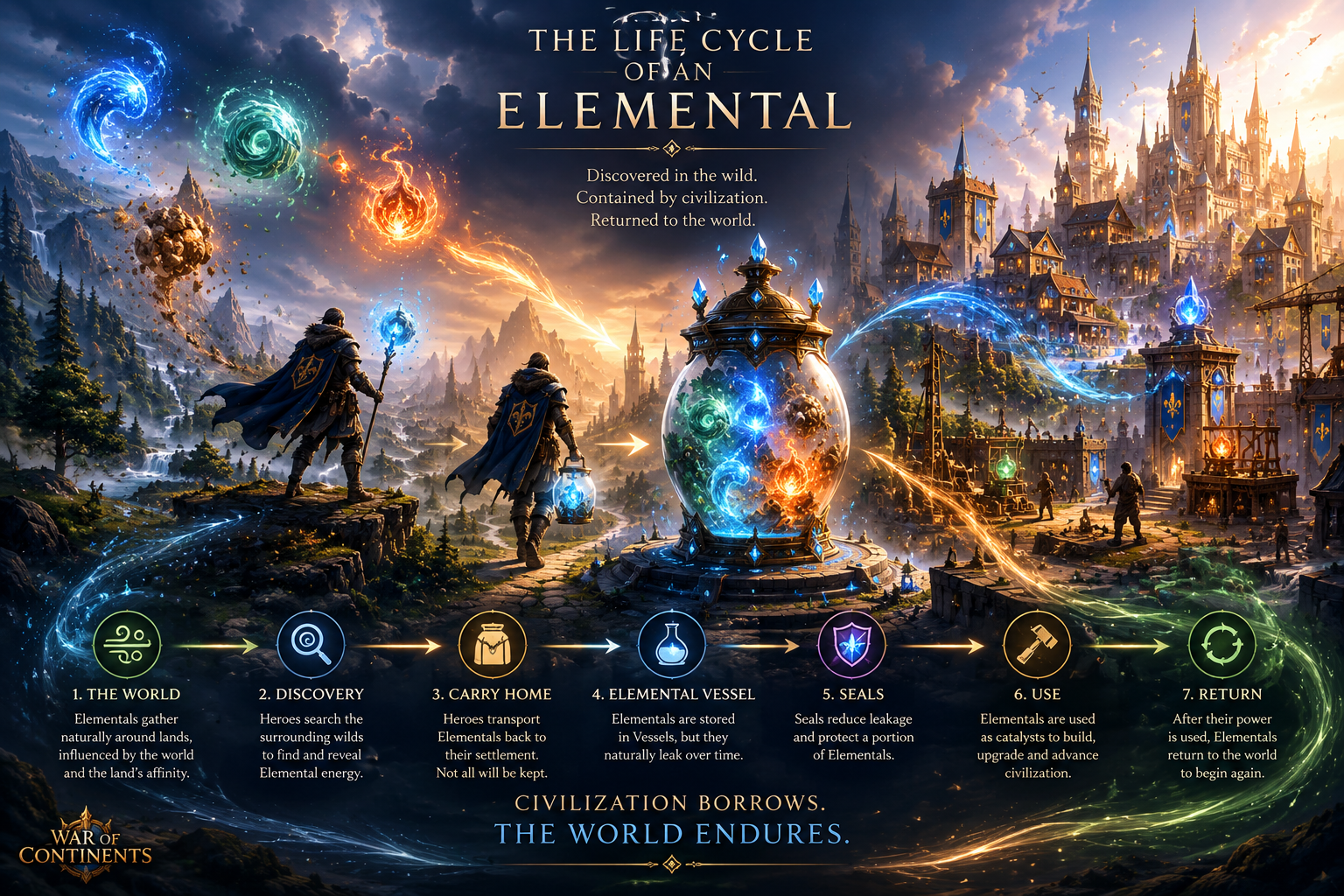
The Lyfe Cycle of an Elementals

Some details will continue to evolve as balancing progresses.

That is expected.

But the principles behind the system are intended to remain part of the world for a very long time.

What Elementals Are

Elementals In The Lore Of War Of Continents

Long before the first settlements appeared, the world was already shaped by the forces of Air, Fire, Water, and Earth.

These forces existed before kingdoms, before roads, before towers, and before civilization itself.

Occasionally, small concentrations of these forces manifest within the world.

These manifestations are known as Elementals.

Elementals are not creatures.

They are not materials.

They are not objects crafted by human hands.

They are fragments of primordial elemental power that have temporarily taken form within the world.

Civilization does not create Elementals.

Civilization discovers them.


Air, Fire, Water, And Earth

Every Elemental belongs to one of the four primordial elements.

🌪️ Air is associated with creation, construction, innovation, and progress.

Many of the structures and advancements that shape civilization owe their existence to the influence of Air.

🔥 Fire is associated with conflict, protection, territorial control, and the projection of power.

Throughout history, Fire has shaped both conquest and defense.

💧 Water is associated with capacity, storage, distribution, and exchange.

Trade, logistics, and the movement of resources all depend upon principles represented by Water.

🌍 Earth is associated with fertility, productivity, abundance, and growth.

The prosperity of lands and the success of many forms of labor are closely connected to Earth.

Although each element expresses itself differently, none is inherently superior to the others.

Civilization depends upon the balance of all four.


Elementals Are Discovered, Not Manufactured

One of the most important principles of the world is that Elementals cannot be manufactured.

Blacksmiths cannot forge them.

Builders cannot construct them.

Merchants cannot produce them.

Elementals already exist within the world.

The challenge is finding them.

Throughout history, civilizations have invested enormous effort into locating elemental manifestations and bringing them under control.

Heroes continue this tradition today.

When a Hero searches for Elementals, they are not creating new elemental power.

They are discovering a fragment of power that already existed somewhere within the world.

Elementals are not produced.

They are discovered.


Why Elementals Leak From Vessels

Elementals possess a unique characteristic.

They resist containment.

Unlike stone, wood, or gold, Elementals do not naturally remain where they are placed.

Even when stored inside specially constructed Elemental Vessels, they gradually disperse over time.

They gradually return to the elemental forces from which they originated.

Others simply vanish beyond the understanding of modern scholars.

This behavior is not considered a flaw.

It is a fundamental property of Elementals themselves.

Because of this, civilizations have spent centuries developing methods to improve containment.

Elemental Vessels, Seals, and other technologies exist for a single purpose:

to delay the inevitable return of elemental power to the world.

Core Principle

Elementals are not rare because they are scarce.

They are rare because they are difficult to find, difficult to control, and impossible to hold forever.

No civilization truly owns Elementals.

It merely borrows their power for a time.


Why Elementals Are Essential For Civilization

If Elementals are so difficult to contain, why do civilizations continue searching for them?

The answer is simple.

Elementals make progress possible.

Across the continents, Elementals are used to strengthen infrastructure, improve settlements, and unlock new opportunities for growth.

Yet Elementals are not consumed like ordinary resources.

They are catalysts.

When Elementals are applied to a project, their power is temporarily directed toward a specific transformation.

Once their role is complete, that power gradually returns to the world.

Elementals are not consumed like ordinary resources.

They are catalysts.

Civilization does not burn Elementals as fuel.

Civilization borrows their power.

For a time.

Many of the greatest achievements of civilization would be impossible without them.

For this reason, mastering Elementals remains one of the defining challenges of the world itself.

How The First System Worked

Why The Original System Was Simple

When the First Epoch began, War of Continents was still a very young world.

Many of the systems that exist today had not yet been built.

Heroes were only beginning their journeys.

The economy was still taking shape.

Core progression systems were being introduced for the first time.

At that stage, the most important objective was not depth.

It was creating a stable foundation upon which future systems could be built.

The original Elemental system was designed with that goal in mind.


What The First Version Needed To Solve

The first implementation focused on a few essential ideas.

Players needed a valuable resource that could support construction and progression.

Heroes needed a meaningful activity that could be repeated over time.

Elementals needed to feel different from ordinary resources.

And perhaps most importantly, the world needed its first glimpse of elemental containment and leakage.

The system accomplished all of these goals.

Heroes searched for Elementals.

Elementals were brought back to lands.

Stored Elementals gradually escaped over time.

Seals reduced losses.

Buildings consumed Elementals for upgrades.

The result was a system that was simple, understandable, and capable of supporting the early growth of the world.


Why We Needed To Move Further

As more players joined the world and more systems were introduced, the limitations of the original design became increasingly visible.

Different lands behaved in nearly identical ways.

Searching for Elementals lacked meaningful variation.

Heroes played only a limited role in the overall process.

Most importantly, Elementals gradually started to feel like a resource rather than a natural force of the world.

The original system successfully accomplished its purpose.

The problem was not that it was wrong.

The problem was that the world had grown beyond it.

The next step was not to replace the idea behind Elementals.

It was to bring the mechanics closer to the vision that had always existed behind them.

Looking Back

The original system successfully accomplished its purpose.

The problem was not that it was wrong.

The problem was that the world had grown beyond it.

From Discovery To Civilization

The most significant change introduced by this update is not a new building, a new mission, or even a new balancing model.

The most significant change is a different way of thinking about Elementals.

Elementals are no longer treated as resources that simply appear after completing a mission.

Instead, they are treated as a natural phenomenon that exists independently of players and settlements.

Civilization does not create Elementals.

Civilization discovers them, contains them, and temporarily directs their power.

To understand the new system, it is useful to follow the journey of an Elemental from its appearance in the world to its eventual return.


Elementals Gather Around Lands

Although Elementals exist throughout the world, they tend to accumulate more densely around settled lands.

Scholars continue to debate why this happens.

Some believe Elementals are drawn to concentrations of civilization.

Others argue that settlements are simply established in places where Elementals are already abundant.

Whatever the cause, one fact is clear.

The lands surrounding settlements contain significantly more accessible Elementals than the untouched wilderness beyond.

Not all lands are equal.

Rare lands tend to attract greater concentrations of Elementals than common lands.

More importantly, every land possesses a permanent elemental affinity.

An Air land will naturally attract more Air Elementals.

A Fire land will naturally attract more Fire Elementals.

A Water land will naturally attract more Water Elementals.

And an Earth land will naturally attract more Earth Elementals.

Core Principle

Foundations do not change the nature of a land.

They amplify it.

Elemental Foundations strengthen the existing affinity of a land and further increase the presence of matching Elementals in the surrounding area.


Elemental Fatigue And Recovery

Elemental concentrations are not limitless.

When Heroes repeatedly search the same area, they gradually discover the easiest Elementals to find.

As these nearby concentrations are depleted, further discoveries become more difficult.

This effect is known as Elemental Fatigue.

Importantly, Fatigue does not mean that Elementals are being destroyed.

The surrounding environment simply becomes less concentrated and therefore harder to harvest efficiently.

Over time, elemental forces naturally gather again.

The environment recovers.

New concentrations form.

And the cycle begins anew.


Heroes Search For Elementals

Once Elementals have accumulated around a land, Heroes may attempt to locate them.

Search missions represent expeditions into the surrounding environment in pursuit of elemental manifestations.

The outcome of these expeditions depends on many factors, including the conditions surrounding the land and the capabilities of the Hero conducting the search.

Successful missions reveal Elementals that can potentially be recovered and brought back to civilization.

Not every expedition produces the same result.

Some discoveries are larger than others.

Some elements are more abundant than others.

And some opportunities emerge only under specific conditions.


Carrying Elementals Home

Finding Elementals is only the beginning.

The greater challenge is bringing them home.

Unlike ordinary resources, Elementals actively resist control.

A Hero may discover far more Elementals than they can safely transport.

note

A Hero's success is measured not only by what they discover, but also by what they manage to bring home.

Heroes possess a limited ability to control elemental energy during the journey back to their settlement.

Any Elementals that exceed that limit cannot be contained.

They disperse and return to the elemental environment from which they emerged.

For this reason, finding Elementals is often easier than controlling them.


Elemental Vessels

Recovered Elementals are transferred into Elemental Vessels.

These structures serve as the primary containment system used by civilizations throughout the world.

Without Vessels, long-term storage of Elementals would be impossible.

Every Vessel has a limited capacity.

Expanding that capacity requires both investment and experience.

As rulers gain Profile Levels and deepen their understanding of the world, new Vessel upgrades become available.

This allows more advanced civilizations to contain larger quantities of Elementals than newly established settlements.

Core Principle

Elementals are not rare because they are scarce.

They are rare because they are difficult to find, difficult to control, and impossible to hold forever.

No civilization truly owns Elementals.

It merely borrows their power for a time.


Leakage And Seals

Even the most advanced containment systems are imperfect.

Elementals naturally resist confinement.

As a result, stored Elementals gradually leak from their Vessels over time.

They return to the elemental environment from which they emerged.

Seals exist to slow this process.

By strengthening the bond between Elementals and their Vessel, Seals reduce the rate at which Elementals escape.

More advanced Seals provide an additional benefit.

They establish a protected reserve within the Vessel.

Elementals stored below this threshold become fully secured and no longer leak over time.

info

Elementals below the protected threshold are considered fully secured and no longer leak from the Vessel.

This protected reserve grows as stronger Seals are obtained and upgraded.


Using Elementals

Civilizations do not gather Elementals simply for the sake of collecting them.

Elementals exist to be used.

They support construction, development, and the advancement of civilization.

Yet Elementals are fundamentally different from ordinary resources.

Wood is consumed.

Stone is consumed.

Food is consumed.

Elementals are not.

Elementals are not consumed like ordinary resources.

They are catalysts.

When a building upgrade or other project begins, Elementals are applied at the very start of the process.

Their power drives the transformation that follows.

Once that power has been released, it cannot be recovered.

warning

Elementals are applied at the beginning of a project.

If a mission or upgrade later fails, ordinary resources may be returned, but Elementals are not refunded because their power has already been released.

Eventually, that elemental energy returns to the world.

Civilization does not burn Elementals as fuel.

Civilization borrows their power.

For a time.

And so the cycle continues.

Elementals gather around lands.

Heroes discover them.

Civilizations contain them.

Their power is used.

And in time, they return to the world once again.

Final Notes

We Build The Game By Playing The Game

War of Continents has always been an unusual project.

Many games are developed behind closed doors and revealed only after most systems have already been completed.

War of Continents is evolving differently.

The world is being built while it is being inhabited.

Every mission completed.

Every bug reported.

Every balance discussion.

Every suggestion shared by the community.

All of these things help shape the future of the world.

The First Epoch is not only about building settlements.

It is also about building the game itself.

In many ways, the first settlers are helping create the foundations upon which future generations of players will build.


Balance Will Continue To Evolve

This update introduces new systems, new relationships, and new strategic considerations.

As with any major change, balancing will continue.

Values may be adjusted.

Mechanics may be refined.

Additional improvements will certainly be introduced.

That process is expected.

The purpose of this update was not to deliver a final version of the Elemental system.

The purpose was to establish a stronger foundation for everything that comes next.


More Changes Will Come

Elementals are among the oldest systems in the game.

They are also among the most important.

Because of this, their evolution does not end here.

Future stages of development will continue expanding the role of Elementals within the world.

New mechanics.

New interactions.

New opportunities.

And new challenges.

Many of those future systems become possible because of the foundations introduced in this update.


Why This Update Matters

At first glance, this update introduces only a new mission and a new building.

In reality, it changes something much more important.

It changes the way the world thinks about Elementals.

Elementals are no longer simply rewards obtained from a mission.

They now exist as part of a larger cycle of discovery, transportation, containment, utilization, and return.

That cycle brings the mechanics closer to the vision that has existed behind the world from the very beginning.


Thank You For Building The World With Us

To everyone who has joined us during these early stages:

Thank you.

Thank you for your patience.

Thank you for your feedback.

Thank you for your ideas.

And thank you for choosing to spend your time in a world that is still growing.

The First Epoch

The First Epoch is far from over.

There is still much to build.

And we are only getting started.

· 5 min read
Sergii

Part of the Foundational Principles of War of Continents series.

Many online games combine progression, spending and power into a single system.

The more you spend, the stronger you become.

The more you progress, the more advantages you gain.

Over time, the distinction between achievement and investment often becomes blurred.

From the earliest design stages of War of Continents, we wanted to take a different approach.

We wanted to separate two fundamentally different concepts:

  • mastery of the world;
  • contribution to the ecosystem.

This is why War of Continents has both Profile Levels and VIP Levels.

While they may appear similar at first glance, they serve very different purposes.


What Profile Level Represents

Profile Level represents a ruler's experience, knowledge and understanding of the world.

It reflects how deeply a player has participated in the development of their civilization and how much of the world they have mastered.

Profile progression is earned through gameplay.

Heroes perform missions.

Missions generate experience.

Experience increases Profile Level.

As a player's Profile grows, they gradually unlock access to more advanced systems, technologies and opportunities.

In future Epochs, Profile Levels will become increasingly important as civilization grows more complex.

Profile is not intended to measure wealth.

It is intended to measure mastery.


Why Profile Cannot Be Purchased

One of the core principles of War of Continents is that understanding the world cannot be bought.

A player may acquire lands.

A player may acquire heroes.

A player may support the project.

But none of those actions should automatically grant the same recognition as genuine participation and experience.

Profile progression exists to represent time spent learning the world, making decisions, developing infrastructure and participating in the evolution of civilization.

For this reason, Profile Levels cannot be directly purchased.

They must be earned.


Profile Cannot Be Bought, But Capacity Matters

War of Continents is a strategy game, and strategic capacity matters.

Players with more heroes can perform more missions.

Players who perform more missions can earn experience faster.

This is intentional.

However, there is an important distinction.

Heroes create opportunities for participation.

They do not replace participation itself.

A player with a large civilization but little activity may progress slowly.

A highly active player with a smaller civilization may progress surprisingly far.

Profile growth is therefore influenced by a player's operational capacity, but it is still earned through interaction with the world.

You can expand your ability to participate.

You cannot purchase mastery directly.


What VIP Represents

VIP serves a different purpose.

While Profile reflects mastery of the world, VIP reflects contribution to the ecosystem.

Players contribute to the world in many different ways.

Some contribute through long-term activity.

Some contribute by expanding their civilization.

Some contribute by helping the project grow.

VIP exists to recognize and reward those contributions.

Importantly, contribution and mastery are not the same thing.

A player can be highly experienced without having a high VIP Level.

A player can support the project without having mastered every system in the world.

Both forms of participation are valuable.

They simply represent different things.


How VIP Progression Works

Unlike Profile Levels, VIP progression is not tied exclusively to gameplay experience.

VIP Points can be earned through multiple forms of contribution.

Examples include:

  • participation in certain game activities;
  • referral-based ecosystem growth;
  • expanding a civilization through the creation of new lands and heroes;
  • and, in the future, direct support of the project.

While the sources may differ, they all share a common theme:

VIP reflects contribution to the ecosystem.

The system is intentionally designed so that VIP is not limited solely to direct spending.

Supporting the growth of the world is also considered a meaningful contribution.


VIP Improves The Path

VIP is not intended to replace progression.

It is intended to improve the journey.

VIP may provide:

  • convenience;
  • efficiency;
  • quality-of-life improvements;
  • reduced friction;
  • and greater comfort while managing a growing civilization.

However, VIP should never replace understanding of the world itself.

Supporting the project should make the journey smoother.

It should not bypass the journey entirely.


Profile Unlocks The Path

Profile serves a different role.

As rulers gain experience and deepen their understanding of the world's systems, they gain access to new opportunities.

Profile progression is intended to unlock:

  • new mechanics;
  • advanced infrastructure;
  • deeper civilization systems;
  • future technologies;
  • and increasingly complex forms of gameplay.

The world grows more sophisticated through the Epoch system.

Profile reflects a ruler's readiness to participate in that growing complexity.


Why We Chose This Approach

War of Continents is built around a simple belief:

Players should respect achievement.

When you encounter a ruler with a high Profile Level, you should know that they have spent time in the world.

They have developed their civilization.

They have participated in its evolution.

They have earned that progress.

At the same time, players who support the ecosystem should feel appreciated and rewarded for their contribution.

Both forms of participation matter.

Neither should replace the other.


Looking Toward Future Epochs

As new Epochs introduce additional layers of civilization, the distinction between Profile and VIP will become even more important.

Civilization will become more complex.

New systems will emerge.

New opportunities will appear.

Profile will continue to represent mastery of the world.

VIP will continue to represent contribution to the ecosystem.

Together, they create a progression model that values both participation and support without confusing one for the other.


A Foundational Principle

One of the foundational principles of War of Continents can be summarized in a single sentence:

VIP improves the path.

Profile unlocks the path.

Both matter.

But they are not the same thing.

And preserving that distinction is important for the long-term health of the world we are building together.

· 8 min read
Sergii

Part of the Foundational Principles of War of Continents series.

Many online games are built around seasons.

A season usually means a temporary cycle: new rewards, new competition, new content, and often some form of reset. The world moves forward for a while, then the cycle ends, and the next one begins.

War of Continents is built differently.

We do not use Epochs as seasonal resets.

We use Epochs as stages of civilization growth.

An Epoch is not just a roadmap label or a marketing name for an update. It is a way to build the world in layers, where each layer expands what civilization can understand, build, control and fight for.

This distinction is important.

War of Continents is not meant to be a short-lived game with temporary progression. It is designed as a persistent world: a place with lands, heroes, missions, resources, infrastructure, economy, ownership, alliances, future conflicts and long-term history.

A world like this should not constantly restart.

It should evolve.


Seasons Reset Progress

In many games, seasons are useful because they create fresh starts.

They give players a new race, a new reward track, a new competitive cycle and a reason to return.

But seasons also often imply that progress is temporary.

The current cycle matters until the next one begins.

Then rewards are replaced, rankings are refreshed, and part of the world loses historical weight.

That approach can work well for some games.

But it is not the foundation of War of Continents.

WOC is not designed around disposable progression.

It is designed around persistent development.

Your lands should matter.

Your heroes should matter.

Your infrastructure should matter.

Your progress should become part of the history of the world.


Epochs Expand Civilization

Epochs in War of Continents are not resets.

They are expansions of civilization.

Each Epoch introduces new layers of depth:

  • new mechanics;
  • new forms of progression;
  • new infrastructure;
  • new economic systems;
  • new ways for players to interact;
  • and new strategic possibilities.

The First Epoch does not exist to show everything War of Continents will ever become.

Its purpose is to establish the foundation of the world.

Players receive lands.

Heroes perform missions.

Resources are gathered.

Elementals are discovered.

Infrastructure begins to grow.

This is the first layer of civilization.

Future Epochs will not erase this foundation.

They will build on top of it.


Why We Build In Layers

A large persistent world cannot be built honestly in a single release.

There are always more ideas than time, resources and certainty.

You can design many systems on paper.

You can calculate economy in spreadsheets.

You can imagine how players will behave.

But the real test begins only when actual players enter the world and interact with its systems in ways that were impossible to fully predict.

If we tried to build the complete version of War of Continents before launch, the project could remain in development for years.

There would always be one more missing mechanic, one more system, one more balance issue, one more reason to delay.

Epochs help us avoid that trap.

They allow the world to start living earlier while still preserving a long-term direction.


Each Epoch Tests The Foundation

Every new layer depends on the strength of the previous one.

If the basic mission loop does not work, there is no point in building advanced warfare on top of it.

If resource flow is broken, a complex economy will only make the problem larger.

If player progression feels meaningless, adding more systems will not solve the deeper issue.

This is why Epochs matter.

They allow us to test the foundation before building too much above it.

The First Epoch focuses on the core:

  • lands;
  • heroes;
  • missions;
  • gold;
  • Elementals;
  • seals;
  • towers;
  • and basic progression.

These systems may look simple compared to the long-term vision.

But they are the base layer of the world.

If this layer becomes stable, the next one can be stronger.


Details Matter More Than The General Idea

A high-level plan is important.

But in game development, the details decide whether a system actually works.

How long should a mission take?

How often should a player return?

Does a reward feel meaningful?

Does a cost feel fair?

Is progression too fast, too slow, or simply unclear?

These questions cannot be answered perfectly before players begin using the system.

Epoch-based development allows us to observe the real game, learn from player behavior, adjust weak points and improve the foundation before adding many more layers.

For a persistent world, this is critical.

It is better to strengthen the foundation than to quickly build something impressive but fragile.


Players Evolve Together With The World

One of the foundational principles of War of Continents is that players should evolve together with the world.

Early gameplay should not expose every future system immediately.

The First Epoch introduces the basic laws of the world.

Later Epochs will introduce deeper civilization systems:

  • resource infrastructure;
  • advanced buildings;
  • armies;
  • alliances;
  • crafting;
  • citadels;
  • new continents;
  • diplomacy;
  • and intercontinental conflict.

This gradual growth matters.

It allows players to learn the world step by step.

It also gives veterans the feeling that they were present when the world was younger, simpler and less developed.

That historical memory is important.

A persistent world becomes stronger when players can say:

I was there when this began.


Epochs Preserve Historical Weight

If War of Continents used seasonal resets, early progress would become temporary.

But Epochs are designed to preserve historical continuity.

The world should remember its early lands.

It should remember its first heroes.

It should remember the first settlements, the first major achievements, the first alliances and the first conflicts.

This does not mean that early players should become impossible to challenge.

New players must still have meaningful ways to enter the world.

But it does mean that time, effort and participation should leave a mark.

Progress should have weight.

History should matter.


Why The First Epoch Is Not The Final Form

The First Epoch is not the complete version of War of Continents.

It was never meant to be.

It is the beginning of a world that will grow over time.

At this stage, the focus is on the first layer of civilization:

  • claiming lands;
  • commanding heroes;
  • performing missions;
  • gathering resources;
  • discovering Elementals;
  • improving infrastructure;
  • and establishing the basic rhythm of progression.

Future Epochs will add new layers of complexity.

But those future systems should emerge from the existing foundation rather than replace it.

This is the difference between an Epoch and a season.

A season starts a new cycle.

An Epoch deepens the existing world.


The Practical Side Of Independent Development

There is also a practical reason for this approach.

War of Continents is developed independently.

There is no major publisher behind the project.

Servers, tools, services, infrastructure, visual assets and development all have real costs.

Building a large online world for years in a completely closed mode would be difficult and risky.

An early launch allows the world to begin living.

Players receive something real, not just a promise.

The project receives feedback, activity and support from people who are genuinely interested in its future.

For us, this balance is important.

We do not want to sell only a dream.

But we also do not want to wait for many more years until every planned system is complete.

Epochs allow us to build honestly:

step by step,

layer by layer,

world first.


What Epochs Mean For Players

For players, Epochs mean that War of Continents will grow gradually.

New systems will not appear all at once.

They will be introduced when the world is ready for them.

Some mechanics will be refined.

Some details will improve.

Some decisions will change after we observe the real game.

But the general direction remains stable:

to build a persistent, evolving fantasy civilization ecosystem where progress matters.

Epochs are not a way to reset the world.

They are a way to let the world mature.


A Foundational Principle

One of the foundational principles of War of Continents can be summarized like this:

Epochs expand civilization. Seasons reset cycles.

War of Continents is not built around temporary cycles.

It is built around long-term evolution.

The First Epoch is not the final form of the game.

It is the first real layer of a world that has started to live.

And from here, the world will continue to grow:

step by step,

epoch by epoch.

· 3 min read
Sergii

Update — July 5, 2026: Frontier has evolved. The current free start grants 1 Frontier Land and 2 Frontier Heroes after registration, then +1 Frontier Hero at Profile Level 1 and +1 at Profile Level 2. Read the latest update: The Evolution of Frontier.

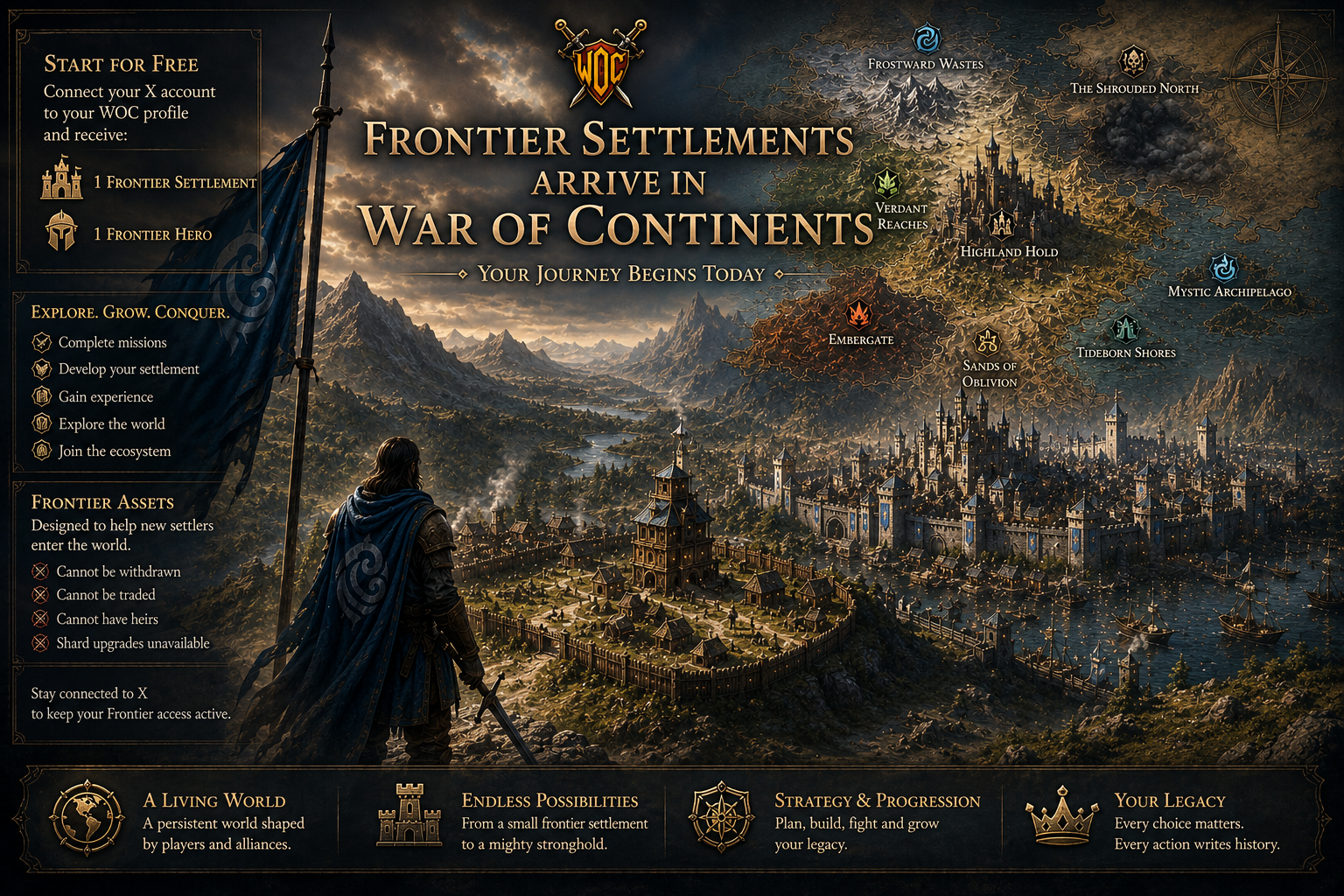
🌍 Frontier Settlements Arrive In War of Continents

Today we are opening a new gateway into the world of War of Continents ⚔️

For the first time, new players can begin their journey absolutely free.

Frontier Settlement

By connecting an X account to your WOC profile and supporting the project, you may receive:

  • 🏰 one Frontier Land
  • 🧙 one Frontier Hero

These assets allow you to explore the world, complete missions, develop your settlement and experience the core gameplay systems of War of Continents without purchasing NFT assets.

🧭 What Are Frontier Assets?

Frontier Settlements and Frontier Heroes are special onboarding assets designed to help new settlers enter the world and begin building their place within it.

Unlike NFT lands and NFT heroes:

  • ❌ they cannot be withdrawn from the game
  • ❌ they cannot be traded
  • ❌ they cannot have heirs
  • ❌ shard upgrades are unavailable

However, in all other aspects they remain fully legitimate gameplay assets inside the world of WOC.

You can:

  • ⚔️ send heroes on missions
  • 📈 gain experience
  • 🏗️ develop your land
  • 🌍 participate in the ecosystem
  • 🚀 progress through the early stages of the game

🔗 Why Are They Connected To X?

Frontier assets remain active while your X account stays connected to your WOC profile.

If the social connection is removed, Frontier access becomes inactive.

We believe this is a fair exchange: a small social connection in return for free access to the world and its onboarding systems.

The goal of Frontier Settlements is not to replace ownership, but to allow new players to safely explore the world before deciding how deeply they want to participate.

💡 A Small Frontier Settlement Can Become The Beginning Of Something Much Larger

One interesting strategy is to start with a free Frontier Settlement and later acquire several additional heroes.

Because settlements are normally the most expensive entry point into the ecosystem, this creates a very affordable way to begin playing more seriously while still benefiting from a persistent long-term world.

🌌 The Beginning Of Your Journey

War of Continents is designed as a persistent fantasy strategy world focused on:

  • 🏰 evolving settlements
  • 📜 long-term progression
  • 🧭 exploration
  • ⚔️ strategy
  • 🌍 living world development

The Frontier system is our way of opening the gates of the world to new settlers.

Your journey can begin today

:::

👉 Play the game: https://game.warofcontinents.online/

👉 Buy platinum, mint lands and heroes: https://warofcontinents.online/

👉 Telegram: https://t.me/gamingplatform89

👉 Twitter: https://twitter.com/WarContinents

👉 Discord: https://discord.gg/cSJBgcmKGS

· 3 min read
Sergii

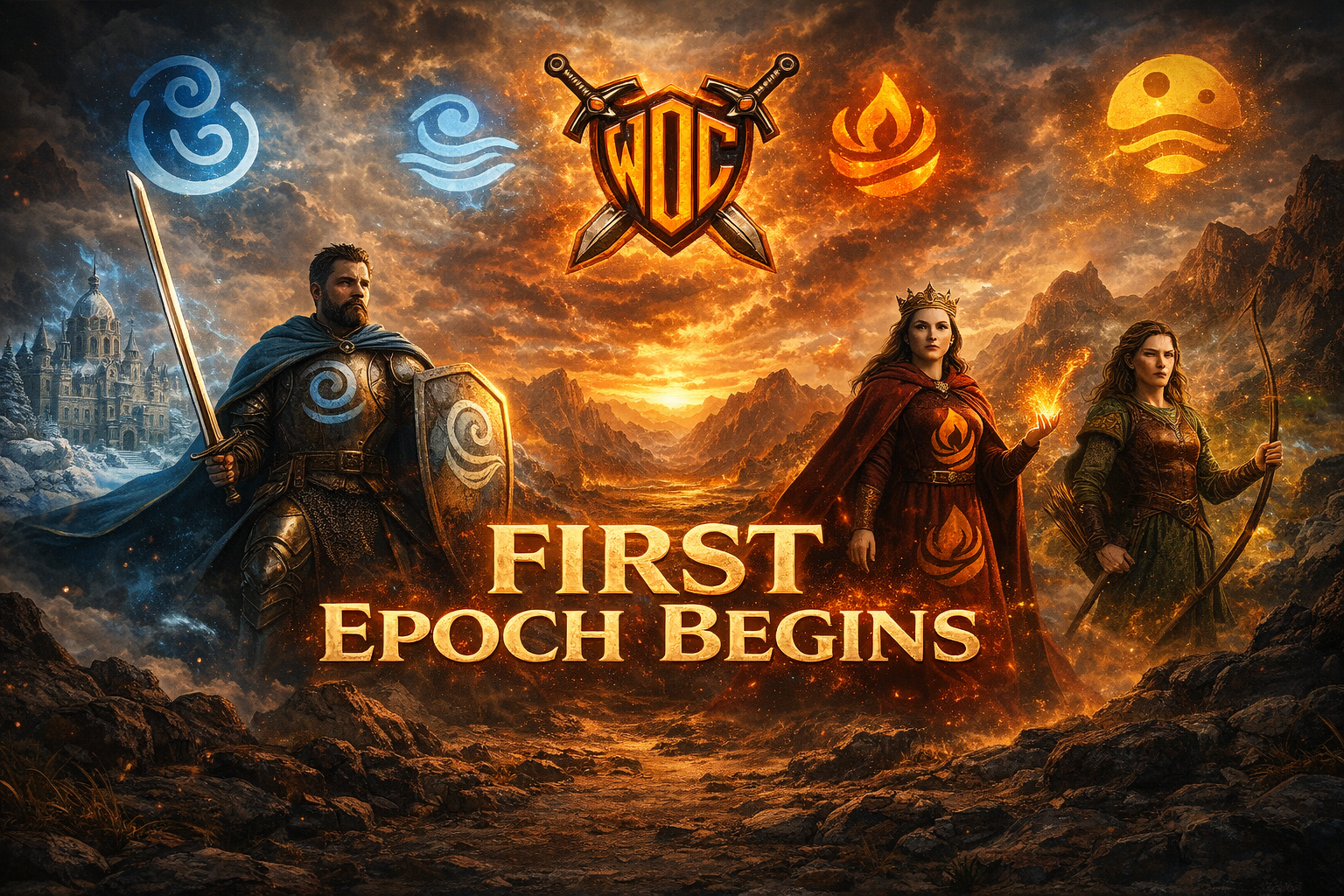
War of Continents is Live — The First Epoch Begins

WOC Live

The moment has arrived.

War of Continents is now live on the production server.

This launch is the result of a long journey filled with constant iteration, difficult decisions, and rethinking core ideas. Many parts of the game were redesigned multiple times. Mechanics were reconsidered, systems were rebuilt, and some solutions were rewritten from scratch more than once before they felt right.

Art direction was its own challenge — finding the right visual identity, balancing style and quality across different rarities, and ensuring the world feels consistent took far more effort than it might seem at first glance.

There were many internal debates about what the game should be — what to keep, what to simplify, what to delay. Step by step, the vision became clearer.

And today, that vision is no longer just a concept.

The world is open, and the First Epoch has officially begun.


The Beginning of a World

The First Epoch is about foundations.

This is where everything starts. Players take their first steps, claim lands, send heroes on missions, gather resources, and begin shaping their own strategies.

This is not about speed. It’s about steady growth, planning, and long-term advantage.

Every action you take now will matter in the epochs to come.


What You Can Do Right Now

The core systems are already live:

  • Mint lands and heroes
  • Send heroes on missions
  • Gather gold and elementals
  • Start developing your lands

No theory — the game is fully playable now.


Launch Offer — Limited Opportunity

To celebrate the launch, a limited offer is now open:

20,000 platinum tokens are available at 25% of the future price.

This is an early entry opportunity for players who want to secure a strong position from the very beginning.

Supply is strictly limited — once these tokens are sold out, the price will return to its planned level.

If you’ve been considering joining, this is the moment to act.


This Is Just the Beginning

The First Epoch is only the foundation.

In the near term, the focus will be on stabilizing the system, fixing minor issues, and refining the existing mechanics.

Once the core is solid and polished, development will move forward — introducing deeper gameplay systems and preparing the transition into the Second Epoch.

War of Continents is designed as a world that evolves over time — and that evolution has now begun.


Thank You

Special thanks to everyone who participated in testing.

During development, the system went through three different release iterations, and each of them brought valuable insights. Testers proved to be highly attentive and genuinely engaged participants, helping to identify issues, challenge assumptions, and improve the overall experience.

You can now log in and claim your previously earned rewards.


Join the World

The world is open.

If you want to be among the first players, build your strategy early, and grow alongside the game — now is the best time to start.

👉 Play the game: https://game.warofcontinents.online/

👉 Buy platinum, mint lands and heroes: https://warofcontinents.online/

👉 Telegram: https://t.me/gamingplatform89

👉 Twitter: https://twitter.com/WarContinents

👉 Discord: https://discord.gg/cSJBgcmKGS

· 2 min read
Sergii

The development of Epoch 1 was a long journey that unfolded through several key stages: an initial design phase followed by three major testing phases. Across all these stages, the game gradually transformed — mechanics were refined, systems were improved, bugs were eliminated, and the vision of War of Continents became clearer and more complete.

Throughout the testing phases, numerous dedicated participants contributed to this progress. They performed daily actions, launched heroes into missions, explored various mechanics, and helped verify the stability and logic of the game systems. Their involvement played a vital role in shaping the version of the game we are preparing to release.

As recognition of this contribution, each participant received a special Testing Medal for every testing phase in which they took part *(you can read more about the medals themselves in the Encyclopedia.

Rewards Before the Launch of Epoch 1

Before the official beginning of Epoch 1, the project team grants valuable rewards for every Testing Medal earned:

  • 1 Land Mint Token
  • 3 Hero Endorsement Letters

These rewards are granted per medal, meaning that participation in multiple testing phases yields multiple sets of prizes. For example, a tester who participated in all three phases will receive:

  • 3 Land Mint Tokens
  • 9 Hero Endorsement Letters

This system reflects our appreciation of the testers’ time, effort, and support throughout the entire pre-launch development cycle.

The testers helped shape the world of War of Continents, and these rewards stand as a token of gratitude for their contributions.

· 3 min read
Sergii

While the First Epoch of War of Continents continues its active testing phase, the world of the Elements does not stand still. Every session, every battle, and every discovery made by players reveals both the strengths of the game and the opportunities for evolution. Out of these countless insights emerged a new concept — Epoch 1.5, the bridge between the First and the Second Epochs.

This intermediate stage is not a separate era but a refinement period, where the game’s foundation is strengthened and carefully polished before expanding into the grand systems of the upcoming Second Epoch. It’s a phase where creativity meets discipline — the time to polish the metal before forging new weapons.


⚙️ Why Epoch 1.5?

Continuous development is the heartbeat of every online world. Yet, too much innovation without stability can blur the game’s core experience. The goal of Epoch 1.5 is to strike a strategic balance: on one hand, to prepare a series of exciting new mechanics; on the other, to focus on optimization, testing, and the elimination of subtle bugs that only reveal themselves after many hours of play.

Epoch 1.5 is therefore a period of internal evolution — improvement without distraction, where both the codebase and the gameplay experience become stronger, smoother, and more rewarding.


🔮 Expected Improvements

The upcoming updates of Epoch 1.5 will gradually introduce new features into the existing gameplay loop — not all at once, but woven naturally into the world players already inhabit.

Among the planned features:

  • Mission Log
  • Use pots to boost skills
  • World Statistics
  • Lucky Coin Event
  • Hero Skills Upgrade
  • Greedy Trader
  • Profiles Rating
  • Seal Improvements
  • Secret Market
  • Unique Missions
  • Arena
  • Referral System

Each addition is designed not only to enrich the player’s toolkit but also to provide new motivations and opportunities for progress.


🧭 Progression and Access

New mechanics will not appear for everyone simultaneously. Their availability will depend on the player’s profile level — a reflection of their activity and contribution within the world. Those who explore more lands, complete missions, and enhance their heroes will naturally unlock new layers of gameplay, while newer players will still have a clear path forward.

In this way, the War of Continents will continue to evolve organically, rewarding dedication and mastery rather than mere time spent online.


🌌 Looking Ahead

Epoch 1.5 is not about expansion — it’s about refinement. It’s the quiet but essential breath before the leap. The systems built during this phase will form the bedrock upon which the grand features of the Second Epoch — resource buildings, hero skills, and hunting expeditions — will rise.

The Elements themselves seem to whisper: perfection precedes power.

· 3 min read
Sergii

War of Continents is not just a game — it is a living world woven from many different forces. On the surface, you see lands, heroes, and missions. But behind the scenes, hidden from the eyes of players, dwell the Jinn.

Technically, War of Continents is a large and complex system. Some of it lives on the blockchain, some runs on our servers. Its architecture is vast, and to manage it, we divided it into smaller parts. In the early days, we could have followed the Unix tradition and called these subsystems “daemons.” But instead we chose something closer to the soul of our project: jinn.

Jinn are not cold lines of code — they are guardians, messengers, and guides. They are forces that make sure the world moves as it should. Sometimes they help directly, sometimes they whisper from the shadows, and sometimes they even send you letters signed with their mysterious names.

Here are a few of the jinn that keep the world alive:

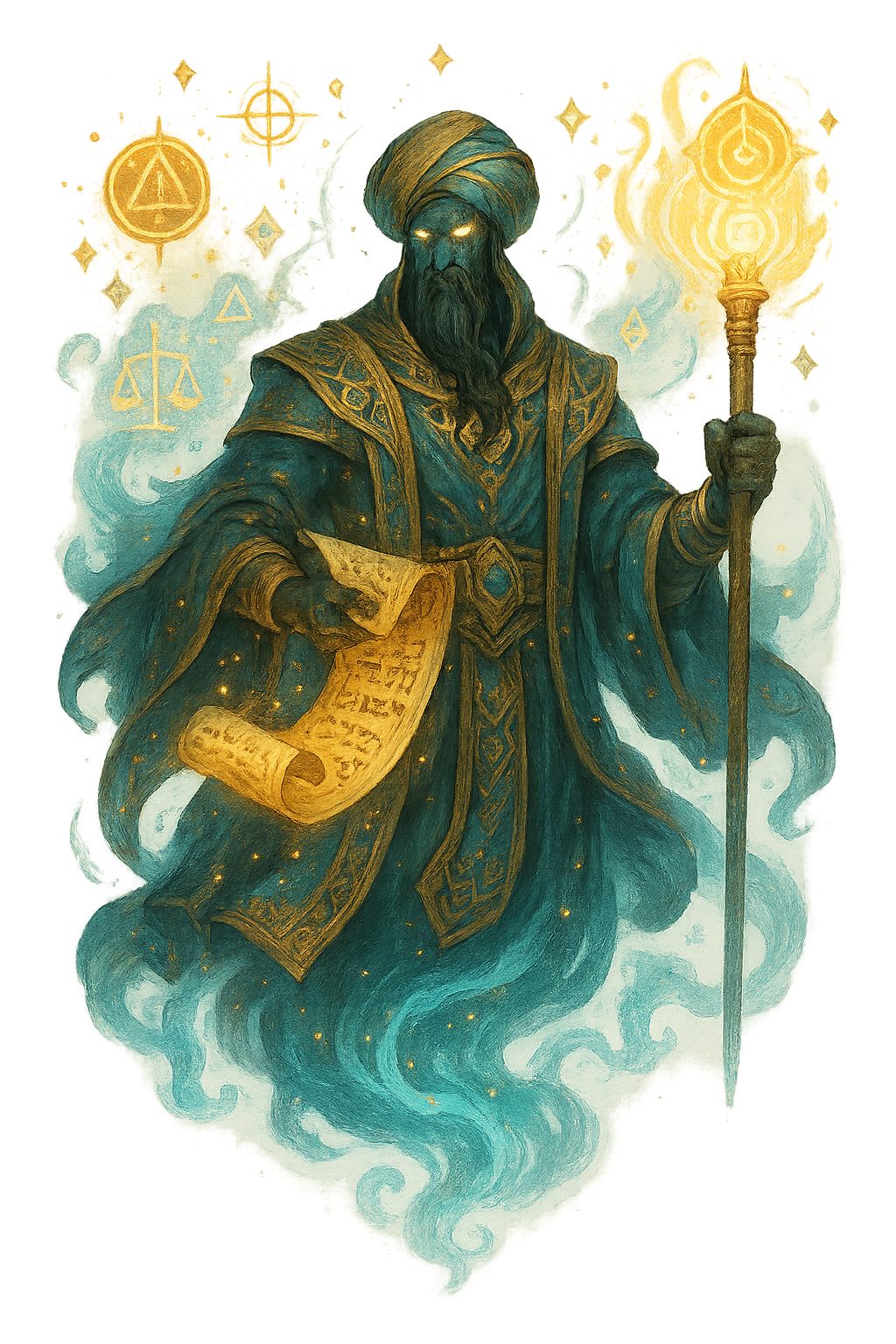
Wakil al-Tartib — The Herald of Order

Wakil al-Tartib is the keeper of process and destiny. He oversees the flow of missions and the unfolding of events, making sure every step follows the next in harmony. When the world of War of Continents runs smoothly, it is because Wakil is at work.

Wakil al-Tartib

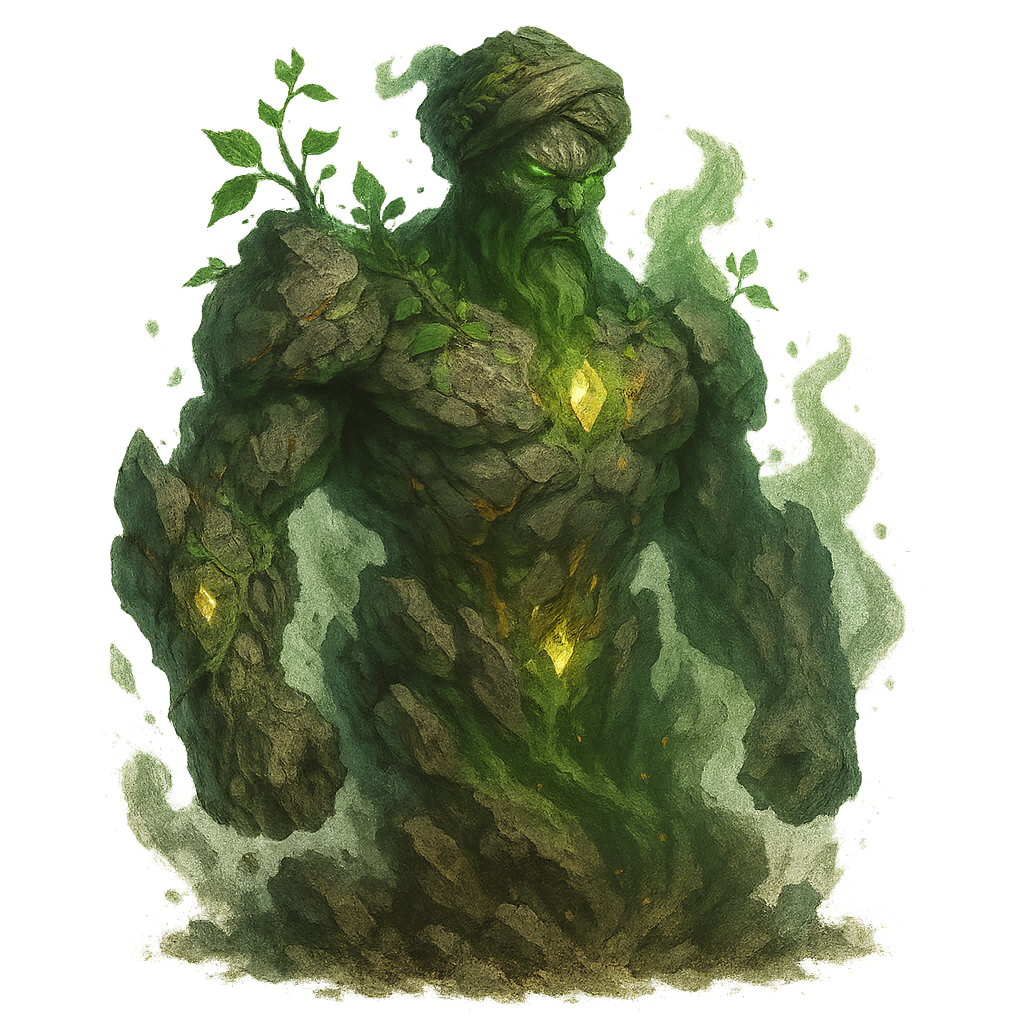
Jinn al-Ard — Keeper of Lands

The lands of players, with their towers, resources, and treasures, belong to the domain of Jinn al-Ard. He records their state, watches over their growth, and ensures they remain a source of wealth and power. If your land yields gold, it is his unseen hand that allows it.

Jinn al-Ard

Sahib al-Abtal — Master of Heroes

Heroes are never truly alone. Sahib al-Abtal tracks their journeys, guards their parameters, and binds them to their masters. He is the one who ensures that every hero knows where they belong, no matter how far their missions take them.

Sahib al-Abtal

Al-Hatif — The Voice That Speaks

Messages do not travel through empty air. Al-Hatif carries voices across the realm, delivering letters between players and even bringing words from the jinn themselves. A strange message may not come from another mortal at all — but from Al-Hatif’s whisper.

Al-Hatif


In this way, what might seem like nothing more than technical modules become part of the living mythos of War of Continents. For developers, the jinn are an architecture of subsystems. For players, they are unseen beings who watch, guide, and sometimes interfere, adding mystery and depth to the world.

The jinn remind us that every great world is built not only on visible lands and heroes, but also on invisible guardians — forces that keep the realm alive.