
Thank You To The First Settlers
Before discussing the update itself, I would like to thank everyone who has joined War of Continents during its earliest days.
Whether you completed missions, reported bugs, shared feedback, participated in discussions, or simply continued exploring the world, you have helped shape the direction of the game.
War of Continents is still a young world.
Many of its systems are evolving. Many are still being built. And many ideas that exist today will continue to improve as we learn from real gameplay and real players.
The first settlers are not simply players.
They are helping build the foundations of the world itself.
For that, I am genuinely grateful.
One Of The Most Important Changes Of The First Epoch
Today we are releasing one of the largest gameplay updates of the First Epoch.
At first glance, it may appear to be little more than a new mission and a new building.
In reality, the changes go much deeper.
This update changes the way Elementals appear around lands.
It changes how they are discovered.
How they are transported.
How they are stored.
And ultimately, how civilization interacts with them.
Many future systems planned for later stages of the First Epoch and beyond depend on the foundations introduced here.
Because of that, this update is much larger than it may initially appear.
Why This Update Matters
Since the earliest design discussions of War of Continents, Elementals were never intended to be ordinary resources.
They were always meant to represent something more fundamental.
Something that existed independently of players.
Something difficult to find.
Something difficult to control.
Something that civilization must gradually learn to understand and master.
The original implementation achieved the practical goals needed to launch the game.
But it represented only part of the long-term vision.
This update brings the Elemental system significantly closer to that vision.
What This Article Will Cover
In this article, I would like to explain:
- what Elementals are within the world of War of Continents;
- why they play such an important role in civilization;
- how the original system worked;
- why it became necessary to evolve it;
- how the new system functions;
- and why these changes matter for the future of the world.
Some details will continue to evolve as balancing progresses.
That is expected.
But the principles behind the system are intended to remain part of the world for a very long time.
What Elementals Are
Elementals In The Lore Of War Of Continents
Long before the first settlements appeared, the world was already shaped by the forces of Air, Fire, Water, and Earth.
These forces existed before kingdoms, before roads, before towers, and before civilization itself.
Occasionally, small concentrations of these forces manifest within the world.
These manifestations are known as Elementals.
Elementals are not creatures.
They are not materials.
They are not objects crafted by human hands.
They are fragments of primordial elemental power that have temporarily taken form within the world.
Civilization does not create Elementals.
Civilization discovers them.
Air, Fire, Water, And Earth
Every Elemental belongs to one of the four primordial elements.
🌪️ Air is associated with creation, construction, innovation, and progress.
Many of the structures and advancements that shape civilization owe their existence to the influence of Air.
🔥 Fire is associated with conflict, protection, territorial control, and the projection of power.
Throughout history, Fire has shaped both conquest and defense.
💧 Water is associated with capacity, storage, distribution, and exchange.
Trade, logistics, and the movement of resources all depend upon principles represented by Water.
🌍 Earth is associated with fertility, productivity, abundance, and growth.
The prosperity of lands and the success of many forms of labor are closely connected to Earth.
Although each element expresses itself differently, none is inherently superior to the others.
Civilization depends upon the balance of all four.
Elementals Are Discovered, Not Manufactured
One of the most important principles of the world is that Elementals cannot be manufactured.
Blacksmiths cannot forge them.
Builders cannot construct them.
Merchants cannot produce them.
Elementals already exist within the world.
The challenge is finding them.
Throughout history, civilizations have invested enormous effort into locating elemental manifestations and bringing them under control.
Heroes continue this tradition today.
When a Hero searches for Elementals, they are not creating new elemental power.
They are discovering a fragment of power that already existed somewhere within the world.
Elementals are not produced.
They are discovered.
Why Elementals Leak From Vessels
Elementals possess a unique characteristic.
They resist containment.
Unlike stone, wood, or gold, Elementals do not naturally remain where they are placed.
Even when stored inside specially constructed Elemental Vessels, they gradually disperse over time.
They gradually return to the elemental forces from which they originated.
Others simply vanish beyond the understanding of modern scholars.
This behavior is not considered a flaw.
It is a fundamental property of Elementals themselves.
Because of this, civilizations have spent centuries developing methods to improve containment.
Elemental Vessels, Seals, and other technologies exist for a single purpose:
to delay the inevitable return of elemental power to the world.
Elementals are not rare because they are scarce.
They are rare because they are difficult to find, difficult to control, and impossible to hold forever.
No civilization truly owns Elementals.
It merely borrows their power for a time.
Why Elementals Are Essential For Civilization
If Elementals are so difficult to contain, why do civilizations continue searching for them?
The answer is simple.
Elementals make progress possible.
Across the continents, Elementals are used to strengthen infrastructure, improve settlements, and unlock new opportunities for growth.
Yet Elementals are not consumed like ordinary resources.
They are catalysts.
When Elementals are applied to a project, their power is temporarily directed toward a specific transformation.
Once their role is complete, that power gradually returns to the world.
Elementals are not consumed like ordinary resources.
They are catalysts.
Civilization does not burn Elementals as fuel.
Civilization borrows their power.
For a time.
Many of the greatest achievements of civilization would be impossible without them.
For this reason, mastering Elementals remains one of the defining challenges of the world itself.
How The First System Worked
Why The Original System Was Simple
When the First Epoch began, War of Continents was still a very young world.
Many of the systems that exist today had not yet been built.
Heroes were only beginning their journeys.
The economy was still taking shape.
Core progression systems were being introduced for the first time.
At that stage, the most important objective was not depth.
It was creating a stable foundation upon which future systems could be built.
The original Elemental system was designed with that goal in mind.
What The First Version Needed To Solve
The first implementation focused on a few essential ideas.
Players needed a valuable resource that could support construction and progression.
Heroes needed a meaningful activity that could be repeated over time.
Elementals needed to feel different from ordinary resources.
And perhaps most importantly, the world needed its first glimpse of elemental containment and leakage.
The system accomplished all of these goals.
Heroes searched for Elementals.
Elementals were brought back to lands.
Stored Elementals gradually escaped over time.
Seals reduced losses.
Buildings consumed Elementals for upgrades.
The result was a system that was simple, understandable, and capable of supporting the early growth of the world.
Why We Needed To Move Further
As more players joined the world and more systems were introduced, the limitations of the original design became increasingly visible.
Different lands behaved in nearly identical ways.
Searching for Elementals lacked meaningful variation.
Heroes played only a limited role in the overall process.
Most importantly, Elementals gradually started to feel like a resource rather than a natural force of the world.
The original system successfully accomplished its purpose.
The problem was not that it was wrong.
The problem was that the world had grown beyond it.
The next step was not to replace the idea behind Elementals.
It was to bring the mechanics closer to the vision that had always existed behind them.
The original system successfully accomplished its purpose.
The problem was not that it was wrong.
The problem was that the world had grown beyond it.
From Discovery To Civilization
The most significant change introduced by this update is not a new building, a new mission, or even a new balancing model.
The most significant change is a different way of thinking about Elementals.
Elementals are no longer treated as resources that simply appear after completing a mission.
Instead, they are treated as a natural phenomenon that exists independently of players and settlements.
Civilization does not create Elementals.
Civilization discovers them, contains them, and temporarily directs their power.
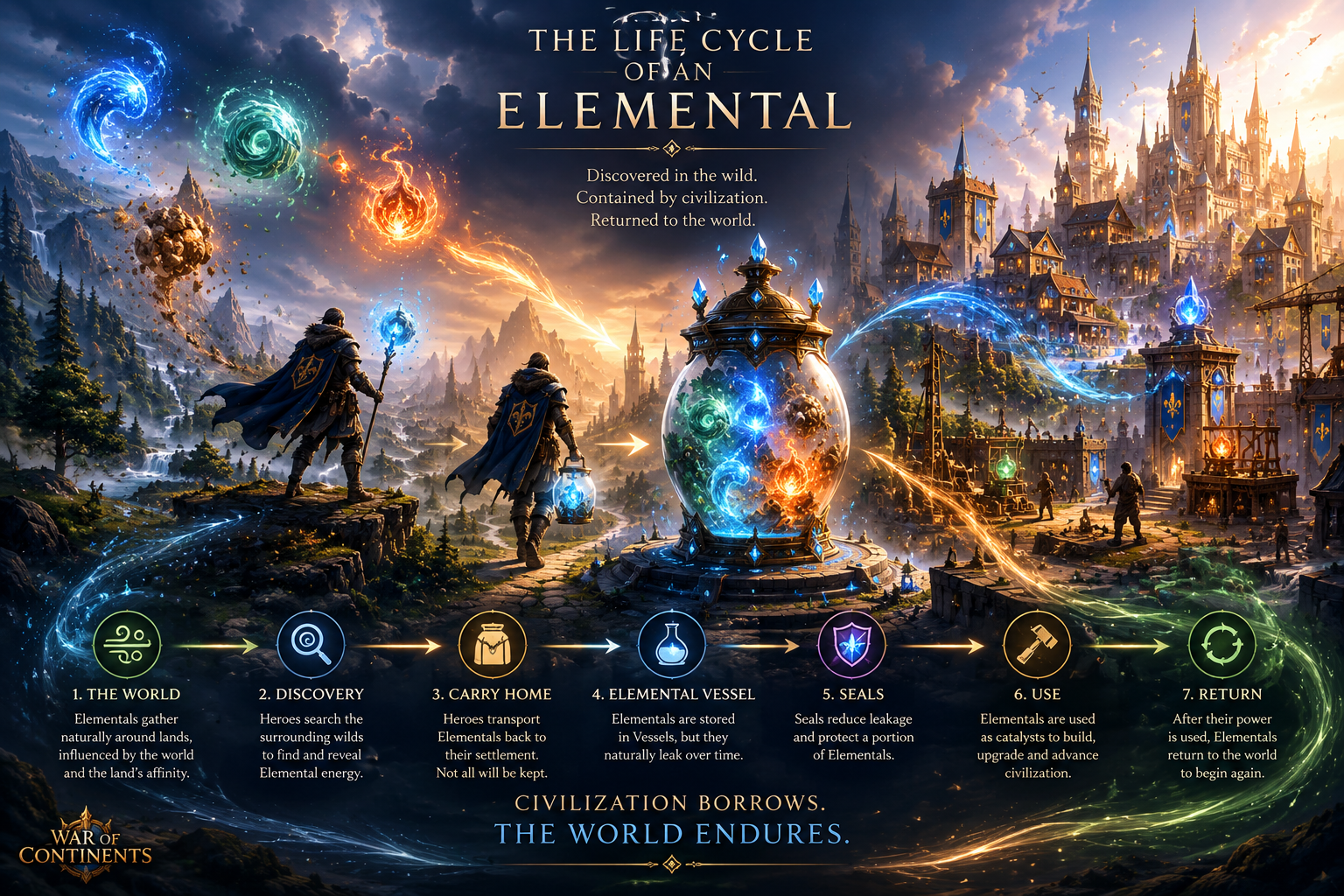
To understand the new system, it is useful to follow the journey of an Elemental from its appearance in the world to its eventual return.
Elementals Gather Around Lands
Although Elementals exist throughout the world, they tend to accumulate more densely around settled lands.
Scholars continue to debate why this happens.
Some believe Elementals are drawn to concentrations of civilization.
Others argue that settlements are simply established in places where Elementals are already abundant.
Whatever the cause, one fact is clear.
The lands surrounding settlements contain significantly more accessible Elementals than the untouched wilderness beyond.
Not all lands are equal.
Rare lands tend to attract greater concentrations of Elementals than common lands.
More importantly, every land possesses a permanent elemental affinity.
An Air land will naturally attract more Air Elementals.
A Fire land will naturally attract more Fire Elementals.
A Water land will naturally attract more Water Elementals.
And an Earth land will naturally attract more Earth Elementals.
Foundations do not change the nature of a land.
They amplify it.
Elemental Foundations strengthen the existing affinity of a land and further increase the presence of matching Elementals in the surrounding area.
Elemental Fatigue And Recovery
Elemental concentrations are not limitless.
When Heroes repeatedly search the same area, they gradually discover the easiest Elementals to find.
As these nearby concentrations are depleted, further discoveries become more difficult.
This effect is known as Elemental Fatigue.
Importantly, Fatigue does not mean that Elementals are being destroyed.
The surrounding environment simply becomes less concentrated and therefore harder to harvest efficiently.
Over time, elemental forces naturally gather again.
The environment recovers.
New concentrations form.
And the cycle begins anew.
Heroes Search For Elementals
Once Elementals have accumulated around a land, Heroes may attempt to locate them.
Search missions represent expeditions into the surrounding environment in pursuit of elemental manifestations.
The outcome of these expeditions depends on many factors, including the conditions surrounding the land and the capabilities of the Hero conducting the search.
Successful missions reveal Elementals that can potentially be recovered and brought back to civilization.
Not every expedition produces the same result.
Some discoveries are larger than others.
Some elements are more abundant than others.
And some opportunities emerge only under specific conditions.
Carrying Elementals Home
Finding Elementals is only the beginning.
The greater challenge is bringing them home.
Unlike ordinary resources, Elementals actively resist control.
A Hero may discover far more Elementals than they can safely transport.
A Hero's success is measured not only by what they discover, but also by what they manage to bring home.
Heroes possess a limited ability to control elemental energy during the journey back to their settlement.
Any Elementals that exceed that limit cannot be contained.
They disperse and return to the elemental environment from which they emerged.
For this reason, finding Elementals is often easier than controlling them.
Elemental Vessels
Recovered Elementals are transferred into Elemental Vessels.
These structures serve as the primary containment system used by civilizations throughout the world.
Without Vessels, long-term storage of Elementals would be impossible.
Every Vessel has a limited capacity.
Expanding that capacity requires both investment and experience.
As rulers gain Profile Levels and deepen their understanding of the world, new Vessel upgrades become available.
This allows more advanced civilizations to contain larger quantities of Elementals than newly established settlements.
Elementals are not rare because they are scarce.
They are rare because they are difficult to find, difficult to control, and impossible to hold forever.
No civilization truly owns Elementals.
It merely borrows their power for a time.
Leakage And Seals
Even the most advanced containment systems are imperfect.
Elementals naturally resist confinement.
As a result, stored Elementals gradually leak from their Vessels over time.
They return to the elemental environment from which they emerged.
Seals exist to slow this process.
By strengthening the bond between Elementals and their Vessel, Seals reduce the rate at which Elementals escape.
More advanced Seals provide an additional benefit.
They establish a protected reserve within the Vessel.
Elementals stored below this threshold become fully secured and no longer leak over time.
Elementals below the protected threshold are considered fully secured and no longer leak from the Vessel.
This protected reserve grows as stronger Seals are obtained and upgraded.
Using Elementals
Civilizations do not gather Elementals simply for the sake of collecting them.
Elementals exist to be used.
They support construction, development, and the advancement of civilization.
Yet Elementals are fundamentally different from ordinary resources.
Wood is consumed.
Stone is consumed.
Food is consumed.
Elementals are not.
Elementals are not consumed like ordinary resources.
They are catalysts.
When a building upgrade or other project begins, Elementals are applied at the very start of the process.
Their power drives the transformation that follows.
Once that power has been released, it cannot be recovered.
Elementals are applied at the beginning of a project.
If a mission or upgrade later fails, ordinary resources may be returned, but Elementals are not refunded because their power has already been released.
Eventually, that elemental energy returns to the world.
Civilization does not burn Elementals as fuel.
Civilization borrows their power.
For a time.
And so the cycle continues.
Elementals gather around lands.
Heroes discover them.
Civilizations contain them.
Their power is used.
And in time, they return to the world once again.
Final Notes
We Build The Game By Playing The Game
War of Continents has always been an unusual project.
Many games are developed behind closed doors and revealed only after most systems have already been completed.
War of Continents is evolving differently.
The world is being built while it is being inhabited.
Every mission completed.
Every bug reported.
Every balance discussion.
Every suggestion shared by the community.
All of these things help shape the future of the world.
The First Epoch is not only about building settlements.
It is also about building the game itself.
In many ways, the first settlers are helping create the foundations upon which future generations of players will build.
Balance Will Continue To Evolve
This update introduces new systems, new relationships, and new strategic considerations.
As with any major change, balancing will continue.
Values may be adjusted.
Mechanics may be refined.
Additional improvements will certainly be introduced.
That process is expected.
The purpose of this update was not to deliver a final version of the Elemental system.
The purpose was to establish a stronger foundation for everything that comes next.
More Changes Will Come
Elementals are among the oldest systems in the game.
They are also among the most important.
Because of this, their evolution does not end here.
Future stages of development will continue expanding the role of Elementals within the world.
New mechanics.
New interactions.
New opportunities.
And new challenges.
Many of those future systems become possible because of the foundations introduced in this update.
Why This Update Matters
At first glance, this update introduces only a new mission and a new building.
In reality, it changes something much more important.
It changes the way the world thinks about Elementals.
Elementals are no longer simply rewards obtained from a mission.
They now exist as part of a larger cycle of discovery, transportation, containment, utilization, and return.
That cycle brings the mechanics closer to the vision that has existed behind the world from the very beginning.
Thank You For Building The World With Us
To everyone who has joined us during these early stages:
Thank you.
Thank you for your patience.
Thank you for your feedback.
Thank you for your ideas.
And thank you for choosing to spend your time in a world that is still growing.
The First Epoch is far from over.
There is still much to build.
And we are only getting started.