Elementals, Vessels and Elemental Seals
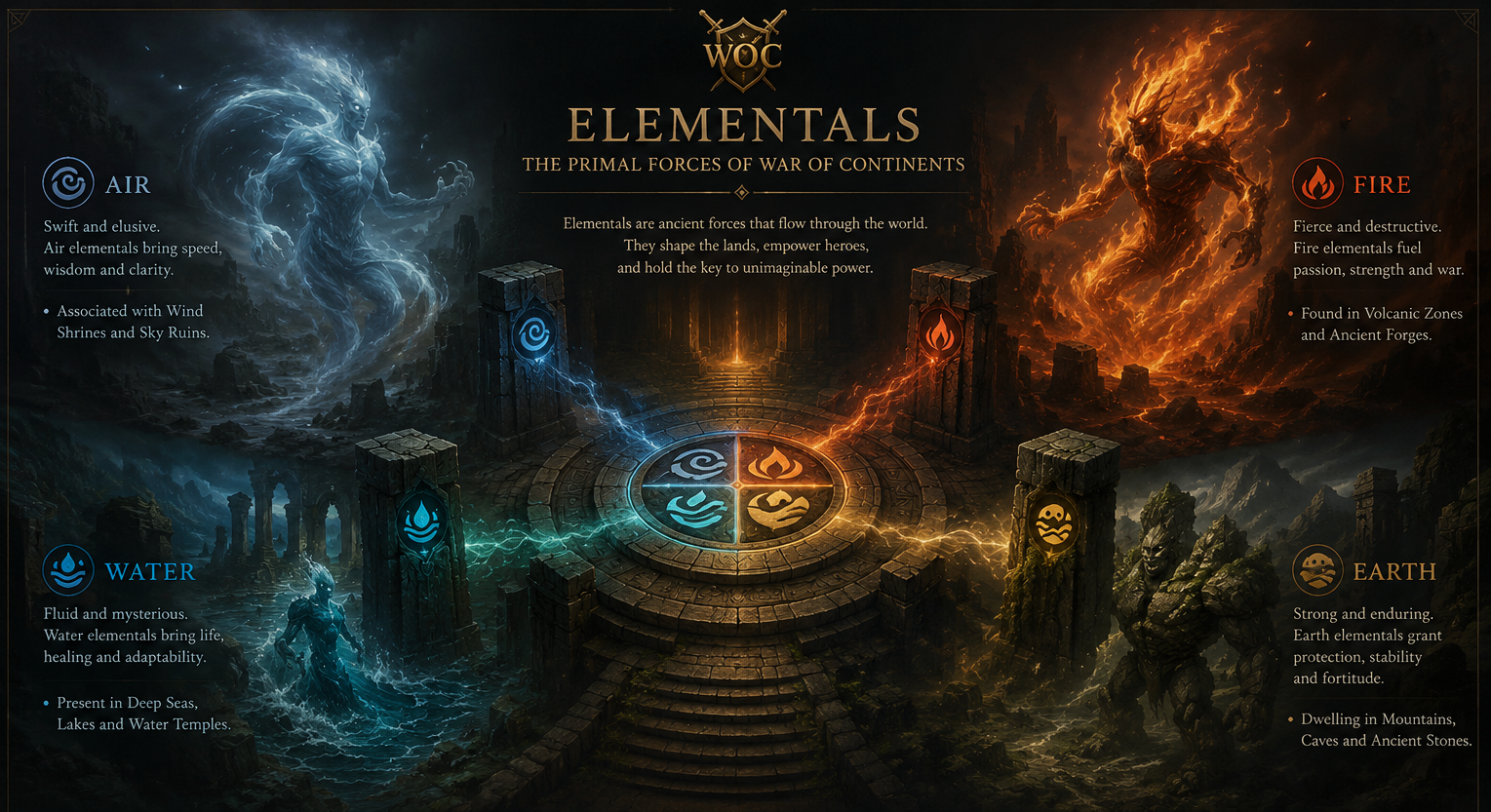
The Nature of Elementals
The world of War of Continents is permeated by elemental forces. These forces manifest as Elementals: unstable fragments of the world's primal elements and concentrated clusters of elemental energy.
The four elemental types are:
- Air
- Fire
- Water
- Earth
Elementals are indivisible. Their quantity is always measured in whole units and never in fractions.
Although Elementals of the same type are interchangeable for gameplay purposes, they are still treated as individual manifestations of elemental force rather than ordinary resources.
Elementals naturally resist containment and try to return to the world. Heroes can locate, capture, and transport them to Lands, but obtaining Elementals is only the first step. Preserving them requires storage infrastructure.
Elemental Vessels
Elemental Vessels are the primary infrastructure responsible for storing Elementals on a Land.
Each Land contains four independent Vessels:
- Air Vessel
- Fire Vessel
- Water Vessel
- Earth Vessel
Elementals of different types never mix. Air Elementals are stored only in the Air Vessel, Fire Elementals only in the Fire Vessel, and so on.
Each Vessel has its own development level and its own stored quantity. Upgrading one Vessel does not upgrade the other three.
Core Storage Principle
Elemental storage capacity is determined by Vessel infrastructure.
Storage capacity is not determined directly by:
- Profile Level
- Hero attributes
- VIP Level
- Elemental Seals
The Vessel itself is the core storage structure. A higher Vessel level provides a higher base capacity, and the matching Element Foundation can add a percentage bonus to that capacity.
This keeps the system split into clear roles:
- Profile Level unlocks how far Vessel infrastructure may be developed.
- Vessels determine how much can be stored.
- Seals determine how well stored Elementals are retained.
- Foundations improve how effectively the Land uses elemental infrastructure.
Vessel Levels and Base Capacity
Each Vessel level has a base storage capacity. Level 0 is the starting state before Vessel upgrades.
In Epoch 1, Vessels can be upgraded up to Level 10.
| Vessel Level | Base Capacity |
|---|---|
| 0 | 30 |
| 1 | 90 |
| 2 | 150 |
| 3 | 200 |
| 4 | 250 |
| 5 | 300 |
| 6 | 350 |
| 7 | 400 |
| 8 | 450 |
| 9 | 500 |
| 10 | 550 |
Base capacity is per Vessel and per Elemental type. For example, a Fire Vessel with a base capacity of 500 can store up to 500 Fire Elementals before Foundation bonuses are applied.
Foundation Capacity Bonus
Element Foundations can increase Vessel capacity for the matching Element.
The capacity calculation is:
capacity = base vessel capacity + round(base vessel capacity * foundation bonus / 100)
Foundation bonus by Foundation level:
| Foundation Level | Vessel Capacity Bonus |
|---|---|
| 0 | 0% |
| 1 | 2% |
| 2 | 5% |
| 3 | 10% |
| 4 | 16% |
| 5 | 24% |
| 6 | 35% |
| 7 | 50% |
| 8 | 70% |
| 9 | 95% |
| 10 | 125% |
This creates the preferred long-term progression chain:
Shards -> Foundation Levels -> Land Bonuses
instead of direct stat bonuses from Shards.
Storage Capacity
Storage capacity is the maximum number of Elementals of a specific type that may be stored on a Land.
For example:
- Fire Vessel base capacity before Foundation bonus: 500
- Current Fire Elementals after mission rewards: 530
- Retained Fire Elementals: capped by the final Vessel capacity
The Land cannot retain more Elementals of a type than the corresponding Vessel allows. If a player wants to accumulate enough Elementals for expensive upgrades, the relevant Vessel may need to be improved first.
Relationship Between Vessels and Towers
There is no direct technical dependency between Vessel level and Tower level.
The system avoids rules such as:
Fire Tower Level 2 requires Fire Vessel Level 2.
Instead, Vessel capacity creates a natural limitation.
For example:
- a Fire Tower upgrade may require a large amount of Fire Elementals;
- the Fire Vessel must be able to store enough Fire Elementals before the player can pay that cost.
The limitation comes from world infrastructure rather than an artificial Tower-to-Vessel level lock.
Relationship With Profile Level
Profile Level does not directly increase Vessel storage capacity.
Instead, Profile Level limits the maximum Vessel level that can be constructed:
| Profile Level | Maximum Vessel Level |
|---|---|
| 0 | 1 |
| 1 | 1 |
| 2 | 2 |
| 3 | 3 |
| 4 | 4 |
| 5 | 5 |
| 6 | 6 |
| 7 | 7 |
| 8 | 8 |
| 9 | 9 |
| 10 | 10 |
Vessel upgrades are sequential. A Vessel can only be upgraded by one level from its current state, and levels above 1 require the player's Profile Level to be high enough.
This follows the principle:
Profile unlocks opportunities. Infrastructure provides capabilities.
Elemental Leakage
No storage can fully prevent Elemental leakage.
Elementals constantly attempt to break free and return to the world. This process is known as Elemental Leakage.
Leakage is measured independently for each Vessel over time, with the Seal's protected reserve acting as the lower bound:
- if a Vessel contains only a few Elementals, absolute losses remain relatively small;
- if a Vessel contains large concentrations of Elemental energy, absolute losses increase proportionally.
Because each Vessel operates independently, leakage is calculated separately for Air, Fire, Water, and Earth.
Elementals that escape from Vessels are not destroyed. They return to the world and become part of the living elemental balance of War of Continents again.
Elemental Seals
Elemental Seals improve containment stability. They do not increase storage capacity.
Seals determine:
- the leakage rate;
- the protected reserve inside the Vessel.
Vessels answer:
How many Elementals can be stored?
Seals answer:
How well can stored Elementals be retained?
Each Seal belongs to a specific Element and may only be applied to the matching Vessel.
Applying a Seal permanently improves that Vessel's containment. The Seal is consumed during the process and becomes part of the Vessel itself.
Seal Progression
Elemental Seals are applied sequentially by rarity:
- No Seal
- Common
- Uncommon
- Rare
- Epic
- Legendary
A Vessel cannot immediately receive a higher-tier Seal without first receiving the previous tiers.
For example:
- a new Fire Vessel starts without a Seal;
- the first improvement is a Common Fire Seal;
- after that, the Vessel may receive an Uncommon Fire Seal;
- later upgrades continue through Rare, Epic, and Legendary.
This progression represents the gradual strengthening of the Vessel's containment structure.
Seal Effects
Current Seal effects are:
| Seal State | Leakage Rate | Protected Reserve |
|---|---|---|
| No Seal | 95% | 5% of Vessel capacity |
| Common | 75% | 10% of Vessel capacity |
| Uncommon | 55% | 15% of Vessel capacity |
| Rare | 35% | 20% of Vessel capacity |
| Epic | 15% | 25% of Vessel capacity |
| Legendary | 5% | 30% of Vessel capacity |
The protected reserve is calculated from the current Vessel capacity, including any matching Foundation capacity bonus. Elementals inside the protected reserve do not leak away.
Relationship With VIP
VIP Level does not affect Elemental storage capacity.
Storage capacity remains tied to Land infrastructure: Vessel level plus matching Foundation bonus. This keeps Elemental storage connected to the Land rather than to account status.
VIP effects on other Elemental systems are Unknown from current code.
Final Architecture
The Elemental storage system is built around three independent layers.
Vessel
Determines:
- storage capacity
Question answered:
How many Elementals can be stored?
Seal
Determines:
- leakage rate
- protected reserve
Question answered:
How quickly do Elementals escape?
Foundation
Determines:
- capacity bonus for the matching Elemental Vessel
- element-specific land infrastructure bonuses
Question answered:
How effectively does the Land use elemental power?
This separation keeps the system understandable, scalable, and consistent with the long-term philosophy of War of Continents.