
Three months ago, War of Continents opened its gates to its very first settlers.
At that moment, the world consisted of little more than ideas brought to life: a handful of lands, a few heroes, and the hope that players would find meaning in building something that could persist for years rather than weeks.
No amount of internal testing could answer the questions that truly mattered.
-
Would players understand the world?
-
Would the economy feel alive?
-
Would the progression systems remain engaging?
-
Would the vision of a persistent civilization prove strong enough to survive its first encounters with reality?
Since launch, those questions have gradually found their answers. The world has grown. Players have left their mark. Systems have evolved. Ideas have been challenged, refined, and sometimes completely reimagined. Some mechanics exceeded expectations. Others revealed weaknesses that only real players could uncover.
This article is not a changelog.
It is a snapshot of the world's first chapter — the people who shaped it, the lessons learned, the milestones reached, and the foundations laid for everything that will follow.
Because one day, years from now, today's thriving civilizations may look back at these first months and remember how small the continent once was.
The World Comes Alive
A persistent world does not become alive because it has maps, heroes, or mechanics. It becomes alive when real people begin living inside it.
Every new settlement, every completed mission, every discovered Elemental and every earned achievement gradually transformed an empty continent into a living civilization.
The First Settlers
War of Continents did not begin with thousands of anonymous accounts.
It began with a small group of early settlers who entered the world while many of its foundations were still being tested, questioned and improved.
During the first three months, 33 players registered in the world, and 17 of them became active participants in its early history.
These numbers also reflect an important part of the world's early evolution.
Many of the first registrations happened before Frontier existed, when entering the game required a much higher level of commitment and NFT assets were the main way to begin playing.
Some players reached the gates of the world before the world had learned how to properly welcome them.
That lesson directly shaped the future of onboarding.
Today, new settlers can start with Frontier Land and Heroes, explore the core gameplay for free, and decide later whether they want to use blockchain ownership features.
| Statistic | Value |
|---|---|
| Registered Settlers | 33 |
| Active Settlers | 17 |
The First Civilizations
The first settlers did not enter an empty interface.
They entered a world built around Lands and Heroes — the two foundations from which every civilization begins.
A Land is more than a place on a map. It is the center of future growth: a source of Gold, Elementals, buildings, storage, missions and long-term development.
A Hero is more than a unit. Each Hero becomes the active hand of a settlement: travelling between Lands, completing missions, gathering resources, hunting Seals and carrying the progress of the player forward.
During the first three months, 56 Lands and 174 Heroes appeared in the world.
Not all of them became active immediately. A meaningful part of these early assets belonged to players who registered before Frontier became the main entry path into the game — before new settlers could easily begin with free Lands and Heroes.
But among those who did enter the world fully, the continent became visibly alive.
36 Lands became active centers of civilization.
120 Heroes took part in the early movement of the world.
| Statistic | Value |
|---|---|
| Lands created | 56 |
| Active Lands | 36 |
| Heroes created | 174 |
| Active Heroes | 120 |
A World In Motion
The strongest sign of life was not the number of registered accounts. It was movement.
During the first three months, Heroes were sent on missions again and again. Lands produced Gold. Elementals were discovered, carried, stored and used for construction. Seals were hunted, and experience accumulated across Profiles and Heroes, turning daily actions into long-term progress.
By the end of this period, the continent had recorded tens of thousands of completed actions across its economy and progression systems. The world was still young, but it was no longer still.
| Activity Metric | Value |
|---|---|
| Missions Completed | 23 702 |
| Gold Claimed | 168 392 |
| Gold Spent | 158 194 |
| Elementals Gathered | 468 417 |
| Experience Earned | 6 179 570 |
| Seals Found | 472 |
Stable Foundations
One of the project's goals from the very beginning was to build a persistent world capable of running continuously.
During its first three months, the live server completed thousands and thousands missions while experiencing only two minor service incidents.
Only 12 missions were lost because of technical problems across the entire period.
For a young persistent world, this mattered. The continent was not only growing, changing and learning — it was able to remain stable while doing so.
The numbers themselves are not the story.
They simply point to something much more important: the continent is no longer empty.
It already has settlements, an economy, achievements and the first traces of its own history.
Most importantly, it has people who entered the world, shaped its earliest days and turned War of Continents from a project into a living place.
A World That Learned
One of the biggest discoveries during the first three months was that a persistent world is never truly finished.
No amount of internal testing can replace real players exploring the world in unexpected ways. Some mechanics proved stronger than expected, while others revealed opportunities for improvement that only became visible after hundreds of completed missions and countless discussions with the first settlers.
As the world grew, so did its understanding of what War of Continents should become.
Frontier Evolution
The journey of new players changed dramatically during these first months.
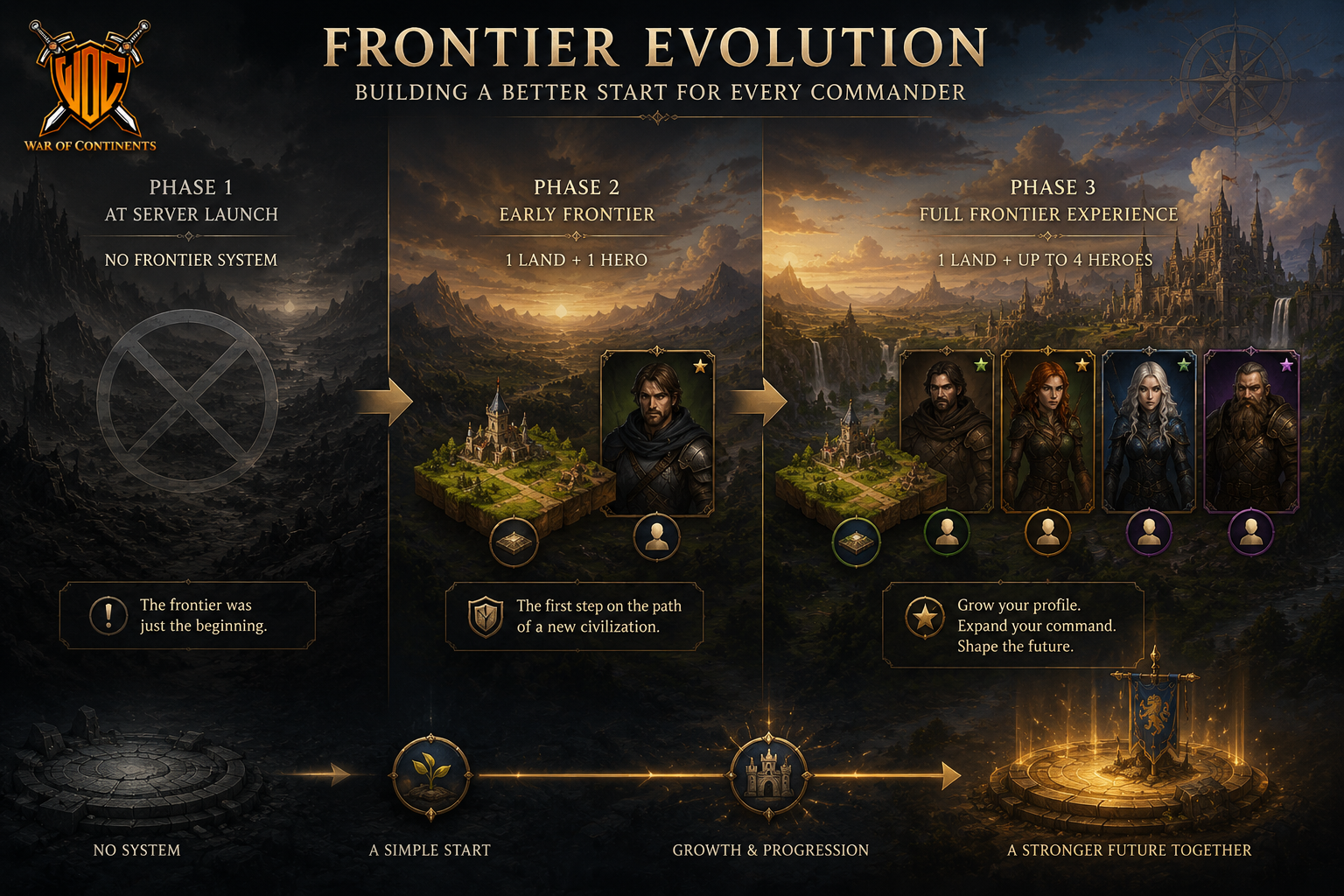
At launch, War of Continents offered no free way to experience the world. Participation began with NFT assets, making the barrier to entry higher than originally anticipated.
The first version of Frontier introduced a free Land and Hero for players who connected their X account. It allowed newcomers to explore the world, but it quickly became clear that a single Hero was not enough to experience the strategic rhythm of the game.
Frontier continued to evolve.
Today every new settler receives:
- one Frontier Land;
- two Frontier Heroes immediately;
- a third Hero upon reaching Profile Level 1;
- a fourth Hero upon reaching Profile Level 2.
Frontier gradually stopped being a way to try the game. It became a genuine way to begin building a civilization.
A Simpler Beginning
Another important lesson concerned the very first minutes inside the game.
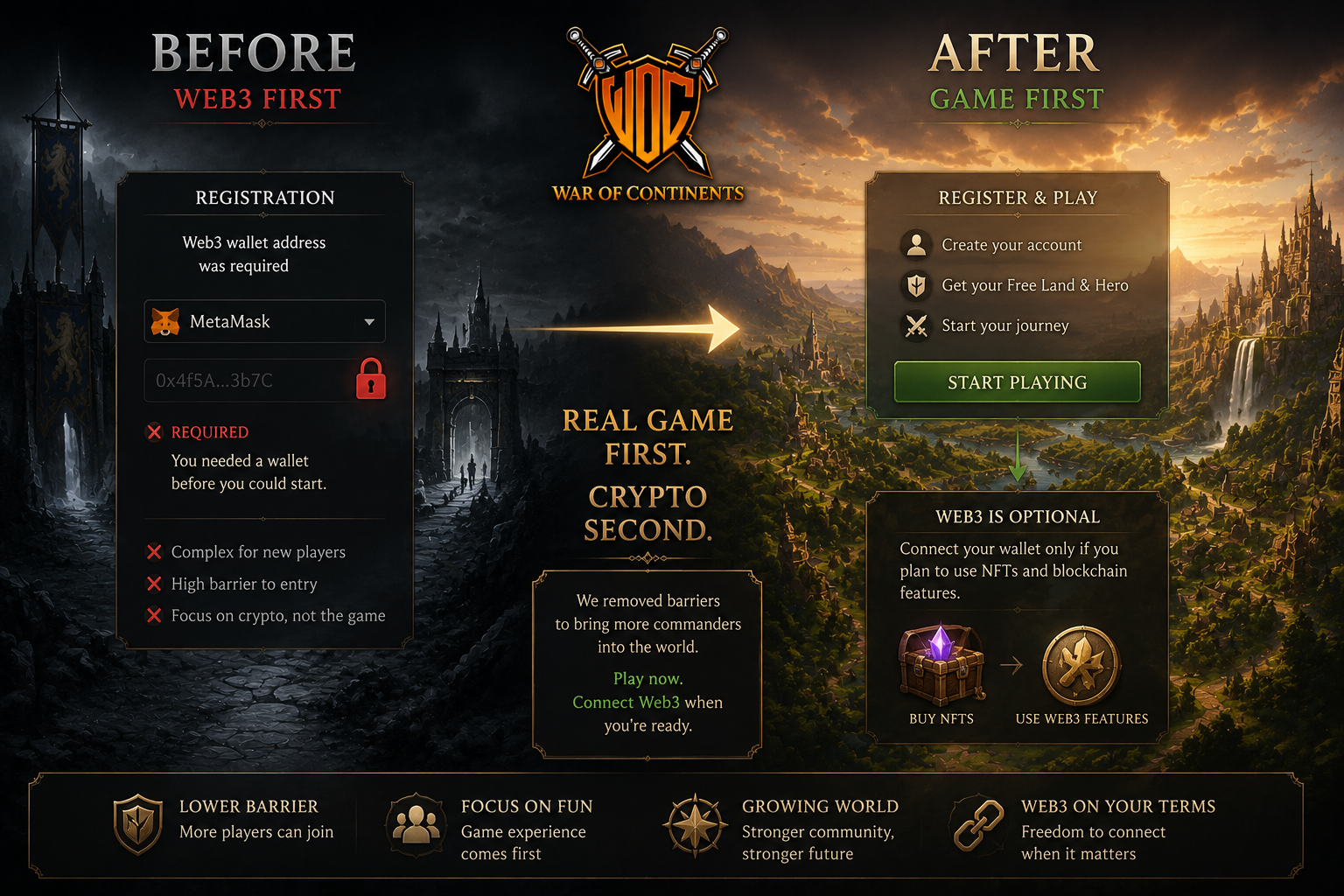
Originally, connecting a MetaMask wallet was a mandatory part of registration. While technically reasonable, it introduced complexity before players had the opportunity to discover whether they even enjoyed the world itself.
That approach has now been completely reversed.
Today anyone can create an account, receive Frontier assets, and begin playing immediately without any blockchain knowledge or wallet connection.
MetaMask remains available for players who later decide to use NFT ownership and blockchain features, but it no longer stands between a new player and the beginning of their journey.
The philosophy became simple:
Play first. Connect later.
A More Coherent Civilization
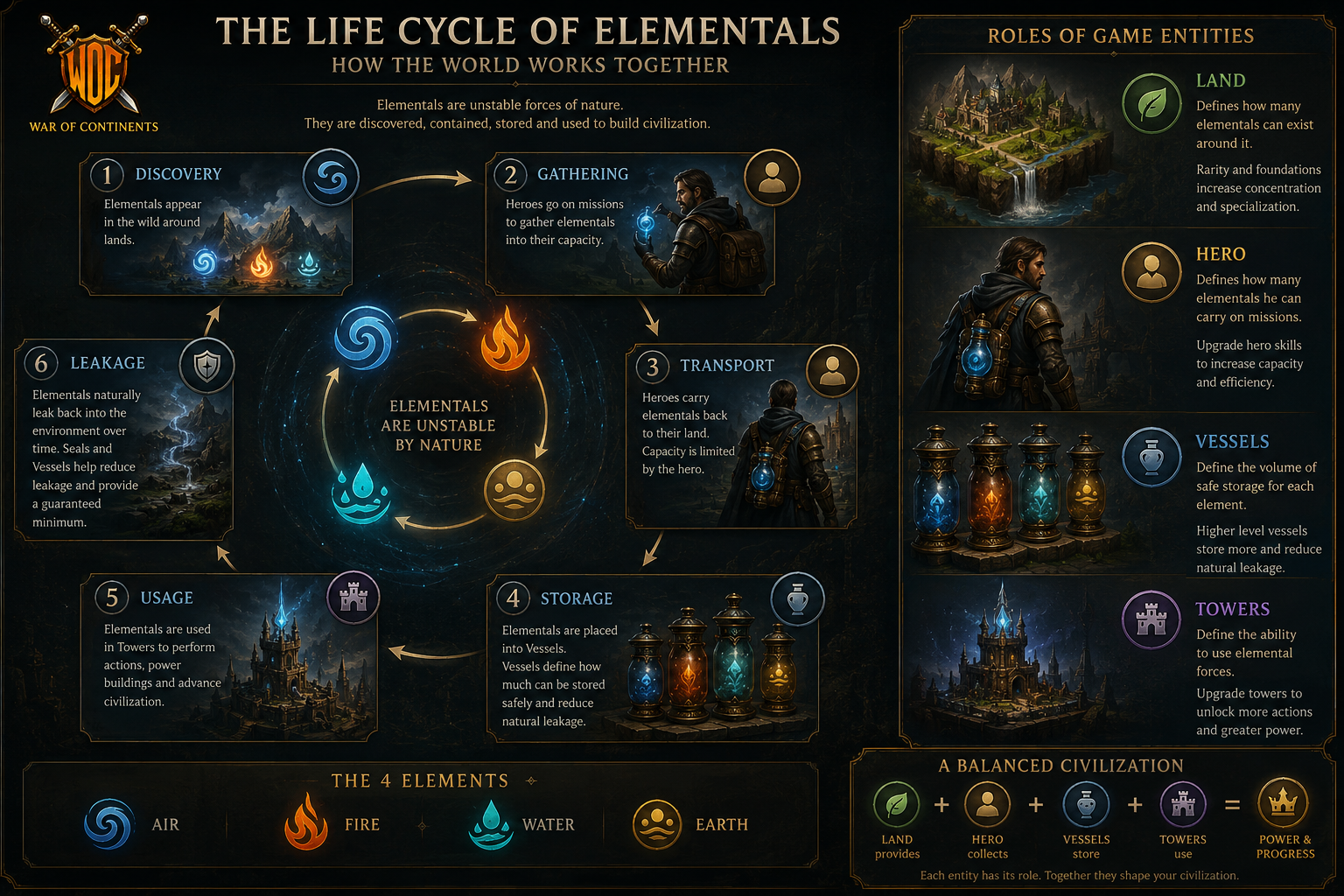
The most significant redesign during these three months took place much deeper inside the world's mechanics.
The original implementation relied heavily on Profile Level to determine many aspects of elemental gameplay. While this simplified the initial release, it gradually became clear that the world itself should define how elemental energy behaves.
The redesign followed one simple principle: every entity in the world should be responsible only for what naturally belongs to it.
Today:
- Lands determine where and how Elementals are discovered.
- Heroes determine how much elemental energy they can transport.
- Elemental Vessels determine how much elemental energy a settlement can safely contain.
- Towers transform that stored energy into long-term civilization growth.
The introduction of Elemental Vessels fundamentally changed settlement progression.
Construction is no longer limited only by discovering Elementals. Civilizations must first develop the infrastructure capable of containing and stabilizing elemental energy before it can be transformed into lasting progress.
The result is a world where every major system has its own clear responsibility, making progression feel more natural, more strategic, and far more coherent than during the earliest weeks after launch.
Built Together With Players
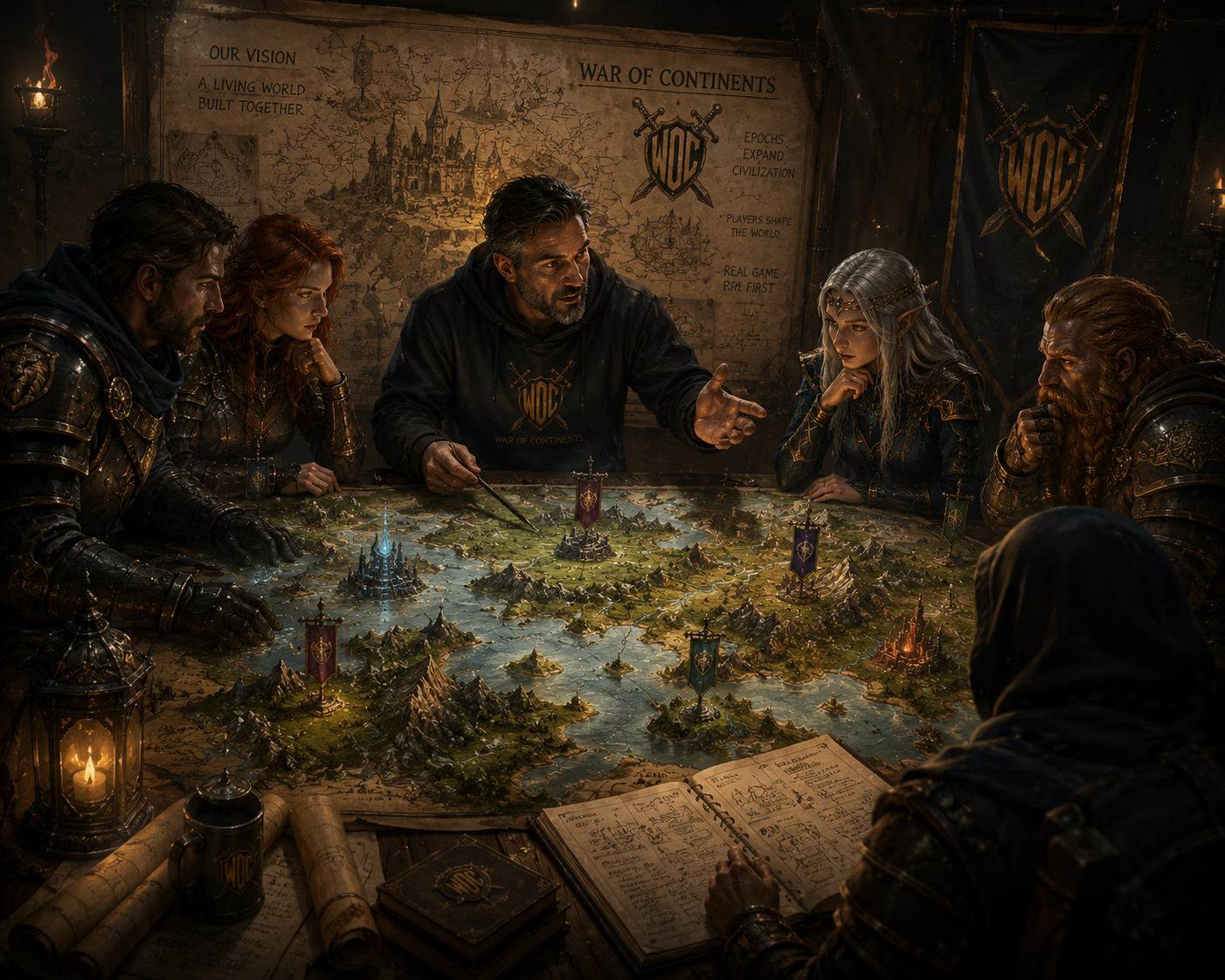
Perhaps the most important lesson of the first chapter was that War of Continents could not be shaped in isolation.
Many of the changes described above began with real players: their questions, suggestions, debates, bug reports and unexpected ways of interacting with the world.
The first settlers did more than complete missions or climb rankings. They tested the foundations of the world while those foundations were still young. Some helped reveal weaknesses. Some suggested better paths forward. Some simply kept playing, returning day after day, proving which systems had enough depth to matter.
Because of them, the world that welcomes new settlers today is richer, clearer and more forgiving than the one that opened its gates three months ago.
They did not only play the first version of War of Continents. They helped build the next one. That is what Play2Build means in practice.
The First Names in History
A persistent world is shaped not only by systems and statistics.
It is shaped by the people who are the first to cross its boundaries, test its limits, and achieve things that no one before them has accomplished.
During the first three months, several settlers began writing their names into the earliest history of War of Continents.
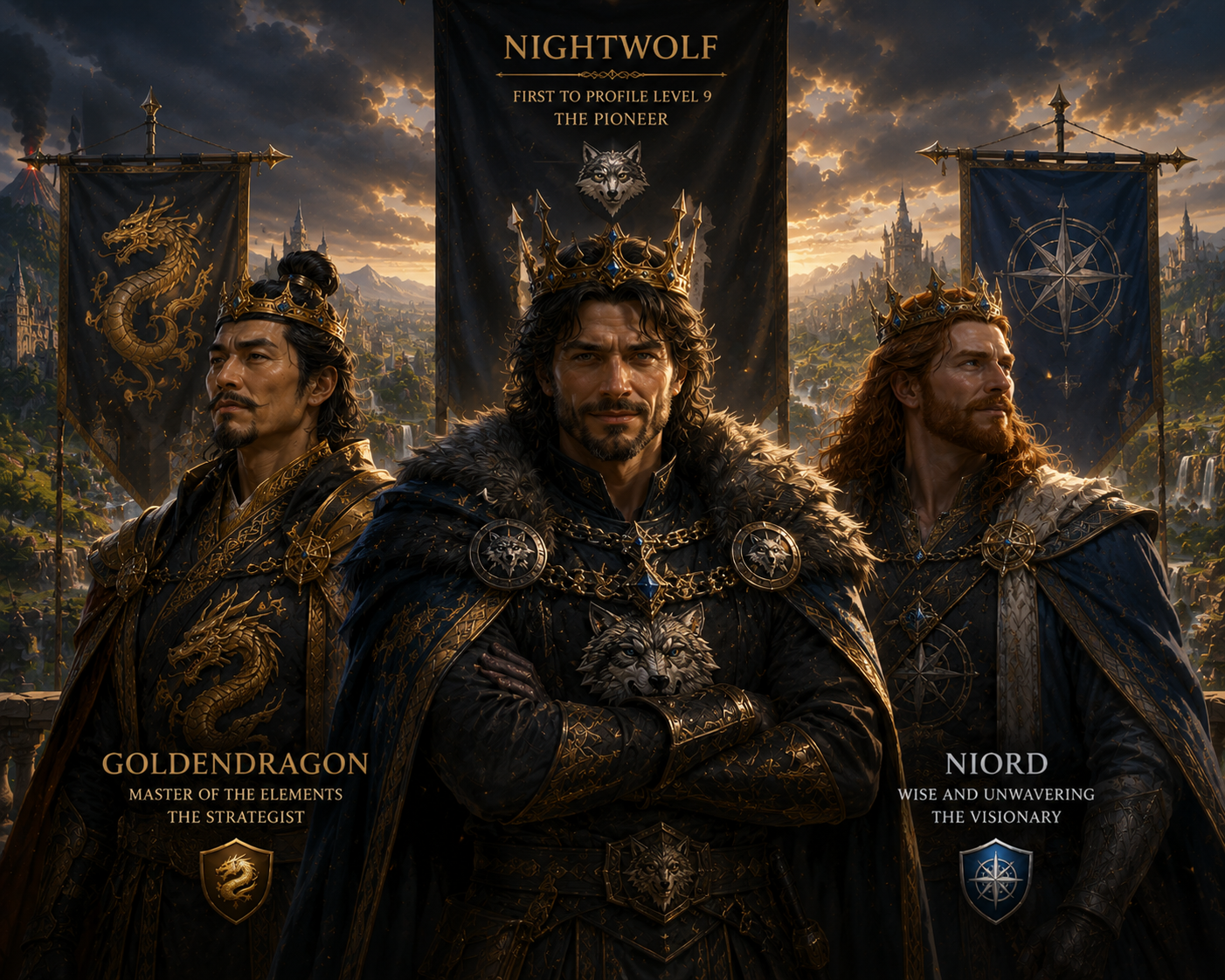
NightWolf
NightWolf became one of the defining settlers of the first months.
- first player to reach Profile Level 9;
- first to upgrade all four Elemental Towers on one Land to Level 4;
- later the first to bring all four Towers to Level 5;
- repeated appearances among the weekly leaders;
- one of the most consistent competitors across multiple rankings.
His progress became one of the clearest examples of how far a dedicated player could advance during the world's earliest stage.
Niord
Niord became one of NightWolf's closest competitors and reached Profile Level 9 only one day later.
- second player to reach Profile Level 9;
- regular leader in Seal Hunting;
- strong results in missions, experience and resource gathering;
- one of the most active participants in the early competition between settlers.
His progress helped turn individual achievements into a real race between the first leaders of the world.
GoldDragon
GoldDragon established a reputation through consistent activity and strong performance across the economy of the world.
- leading positions among Elemental Gatherers;
- strong results in completed missions;
- regular presence near the top of weekly rankings;
- one of the most recognizable names of the first months.
GoldDragon's progress demonstrated the importance of sustained activity and balanced development.
More Than Three Names
The earliest history of War of Continents belongs to more than its leading players.
Settlers such as El Pidoro, jaws1977, Barwar, Udaff4eg, SilkWing, Sir C Maker and others also contributed through missions, discoveries, testing, discussions and feedback.
Their efforts helped move the world forward at a time when it was still fragile, incomplete and learning from every real interaction.
Not every contribution appears at the top of a leaderboard.
Some players helped uncover problems.
Some suggested improvements.
Some simply returned every day and kept the world moving.
Together, they became the first community of War of Continents.
Looking Beyond the Horizon
Three months is a very small chapter in the life of a persistent world.
The first settlements have been founded, the first heroes have earned their place in history, the first rivalries have emerged, and the first lessons have already reshaped the world.
Yet everything described in this article is only the beginning.
The continents remain largely unexplored. Many mechanics still await future epochs. Wars have yet to be fought. Great alliances have yet to rise. Entire civilizations have yet to leave their mark on history.
War of Continents was never designed to be completed within weeks or even months.
It was built with a different ambition: to become a world capable of growing for years, shaped not only by its developer, but by every player who chooses to become part of its history.
Perhaps, years from now, someone will rediscover this article and smile at how small the world once was.
Only a handful of settlers.
Only a few dozen lands.
Only the first names carved into the chronicles.
Every great civilization begins somewhere.
These were the first three months.
The journey has only just begun.