The First Epoch of War of Continents was about personal development.
Players established Lands, trained Heroes, gathered Gold and Elementals, developed Towers and Vessels, hunted Seals, and gradually turned a small beginning into a functioning civilization.
The Second Epoch does not replace that progress.
It gives it a place in the world.
For the first time, Lands are no longer only parts of an individual economy. They have persistent positions on a shared continent. Heroes no longer simply disappear into a Mission timer. They travel from their Homes, cross real distances, become visible to other players, and return after their work is done.
And the world around them does not wait.
Events appear. Rumors spread. Information can be incomplete or wrong. Several civilizations can pursue the same opportunity, while each of them may understand it differently.
This is the beginning of Epoch Two — Roads of Prosperity.
One Continent, 751,501 Cells
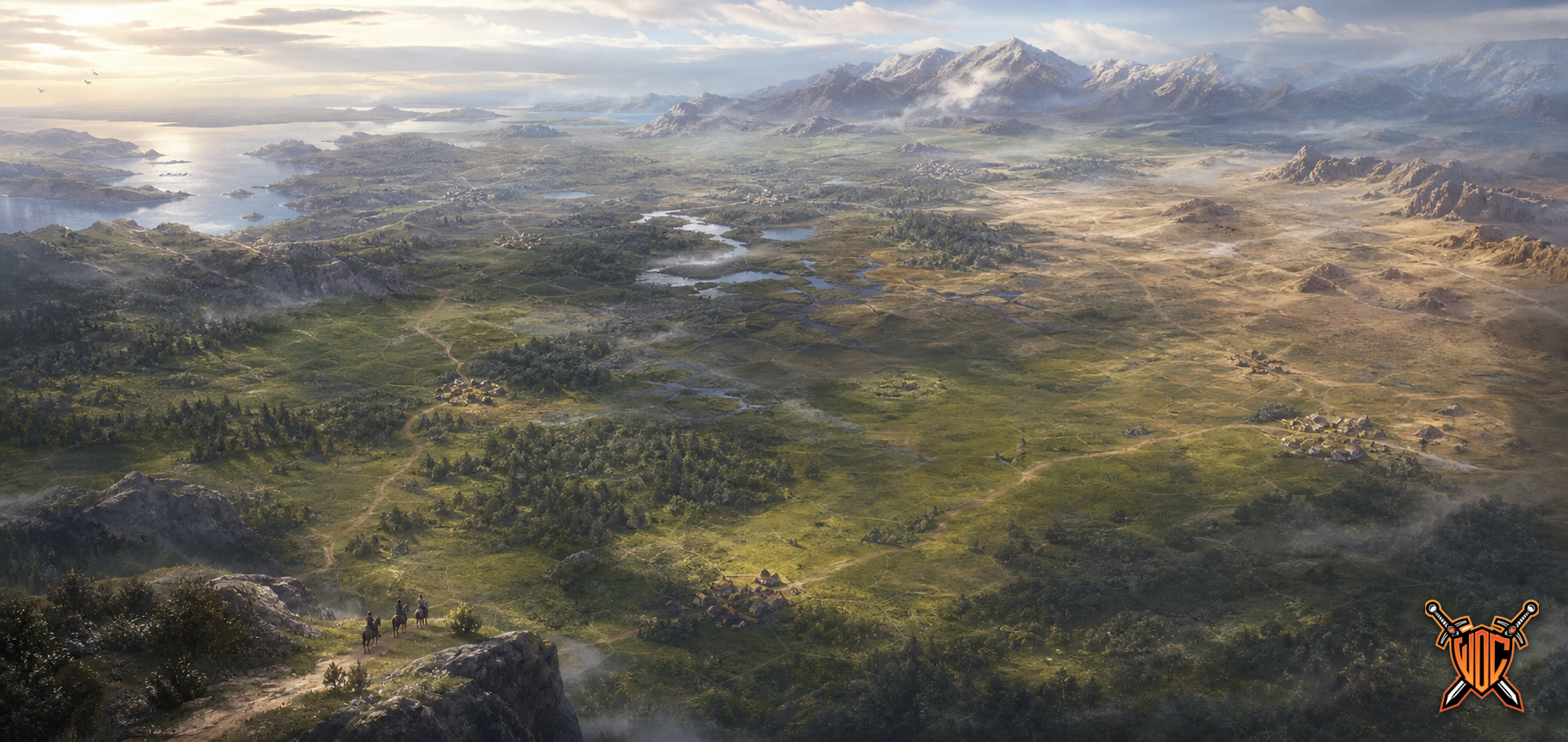
The first continent of War of Continents is called Alef.
Alef is one persistent hexagonal world with a radius of 500 cells. A hexagon of that size contains:
1 + 3 × 500 × 501 = 751,501 playable cells
Every cell inside the permanent border belongs to the playable geography of the continent. This does not mean that every cell is always empty or available for placement: Lands and other occupying World Objects can already have a position there. It means that the interior is one continuous world rather than a collection of isolated player boards.
The geography is persistent. A location keeps the same coordinates and the same visual terrain between visits. Forests, grasslands, wetlands, dry steppe, desert, tundra, and alpine areas give different parts of Alef their own visual identity.
For now, biome terrain provides context and atmosphere. It does not automatically change Hero movement speed, Land rarity, production, rewards, ownership, placement rules, or Mission outcomes. The map shows where a civilization lives without silently adding rules that the player cannot see.
Three Ways to See the Same World
Players explore Alef through three complementary views.
Local is the primary gameplay view. It shows a detailed radius-5 area containing up to 91 playable cells before border clipping. This is where players inspect Lands, Rumors, known Events, and active movement, select map records, preview routes, and begin map Missions.
Medium expands the view to a radius-20 area. It is designed for regional orientation: finding nearby civilizations, following activity, identifying interesting directions, and choosing a location to open in Local detail.
Whole Map presents the entire continent as a large strategic selector. It uses a coarse terrain sample rather than loading every detailed cell and lets the player quickly choose which region of Alef to explore next.
These are not three different maps, and they are not merely graphical zoom levels. They are three windows into the same persistent continent, each designed for a different scale of decision.
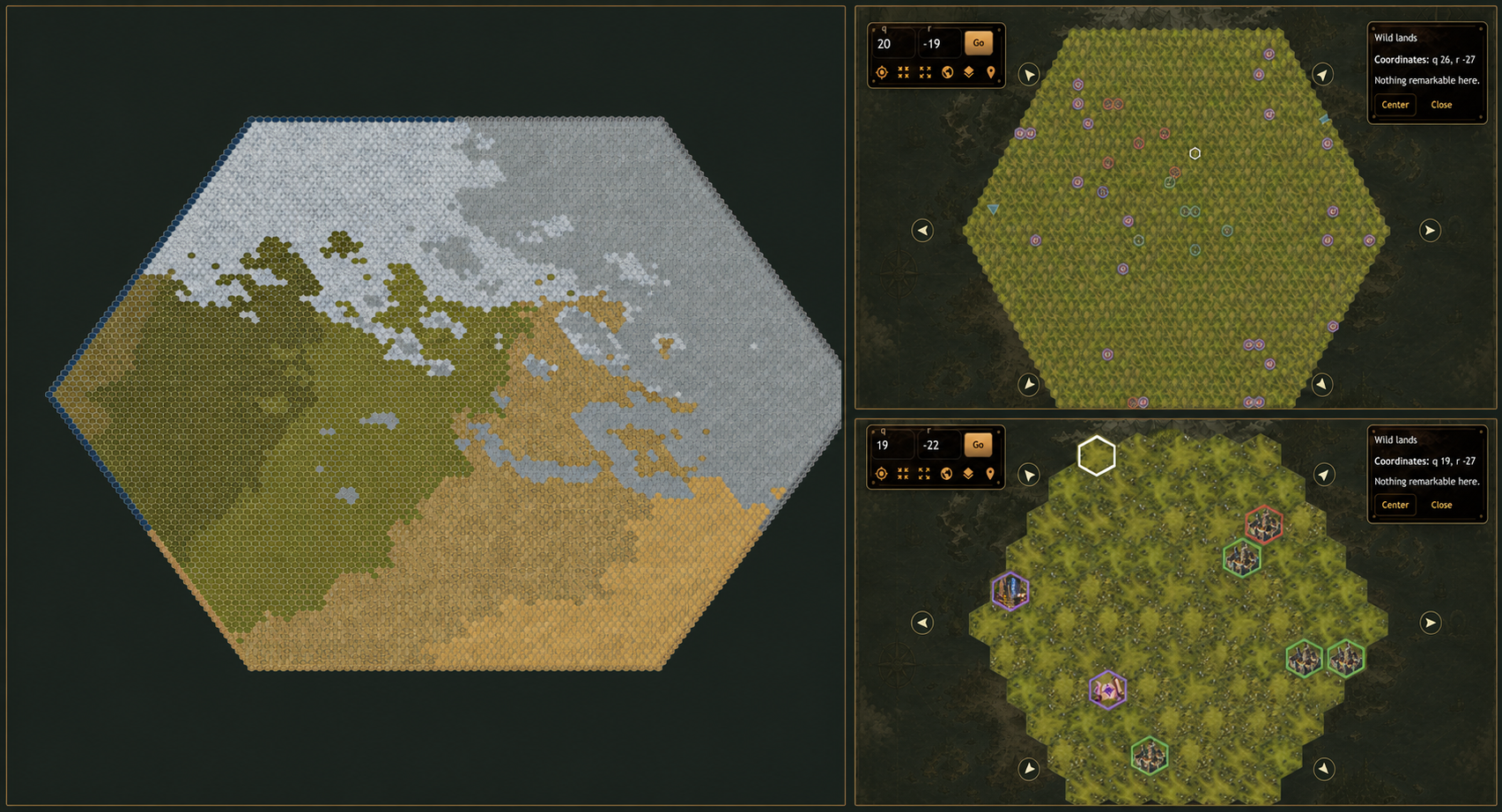
One world at three scales: the whole continent, the surrounding region, and the local playable area.
Every Civilization Has a Place
Before a Profile can enter the World Map, it establishes its own Civilization Center.
The Center is a persistent geographic anchor for the Profile rather than a separate building occupying a public map cell. The player does not select its exact coordinates, but the decision is not completely random.
On first use, the player chooses:
- one of six broad sectors of Alef;
- whether the civilization should be placed closer to others, at a balanced distance, or farther away.
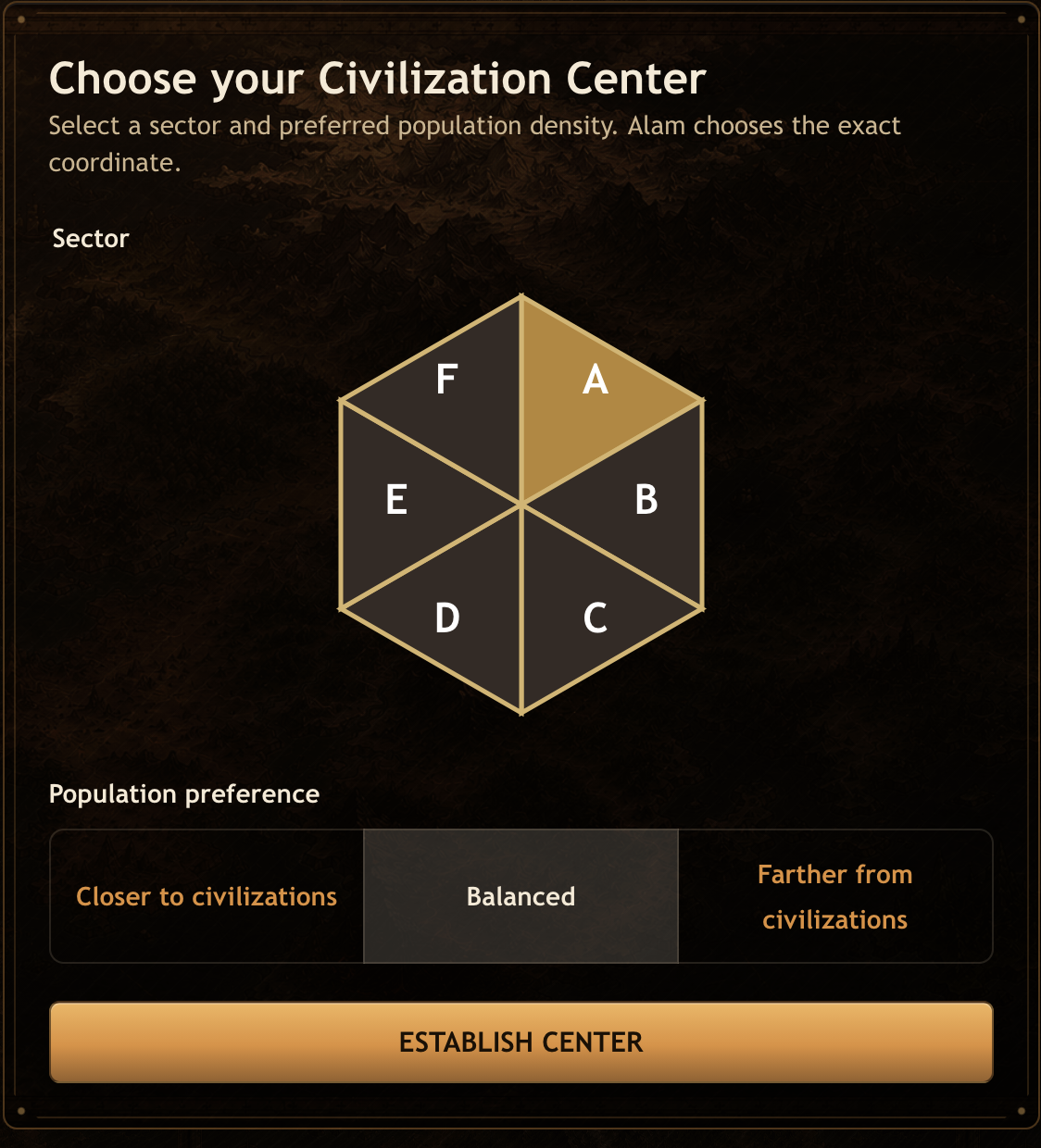
The player chooses a broad sector and a population preference; Alam determines the exact coordinate.
The world then selects an exact valid position matching those preferences as closely as current settlement patterns allow.
Every active Land already controlled by the Profile is placed automatically near that Center. Lands are processed in random order, and Alam randomly selects an available playable cell in the nearest area with free space, expanding the search outward only when necessary. The player neither chooses nor rerolls the exact coordinates.
Each Land occupies one complete hexagonal cell. Two Lands cannot occupy the same cell at the same time. Once placed, a Land has a persistent position in the shared world.
This is where geography begins to matter.
A Land is now a Home, an origin, a destination, and a visible part of the continent. The distance between that Land and an opportunity elsewhere on Alef becomes part of every decision that follows.
One World, Shared Opportunities
Alef is not a private map generated separately for every player.
Its changing opportunities are shared.
Temporary World Events appear across the continent. Stage 1 begins with fourteen Event types organized into four Mission families. Events exist for a limited time and can expire, be cancelled, or be completed.
Most importantly, an Event is not copied for each Profile.
If several civilizations learn about the same Event, they are pursuing the same opportunity. Sending a Hero does not reserve it. Another Hero may already be travelling toward it, and the Event's availability is checked when each Hero actually arrives.
The first eligible Mission to capture an available Event can begin the work. Other expeditions may discover that the opportunity is already being handled or has disappeared and return Home without performing the Mission.
This is the first form of influence on the World Map. It is not territorial ownership or conquest. It is presence expressed through movement, information, timing, and action. When one civilization acts, the possibilities available to its neighbors can change.
A World in Motion
Active Hero journeys are publicly visible on the continent.
The map distinguishes your own movement, movement belonging to a current Guild member, and other movement. It can show the traveller's public owner name, route, and arrival time. It does not reveal the complete internal purpose of another player's Mission, but direction and timing can tell their own story.
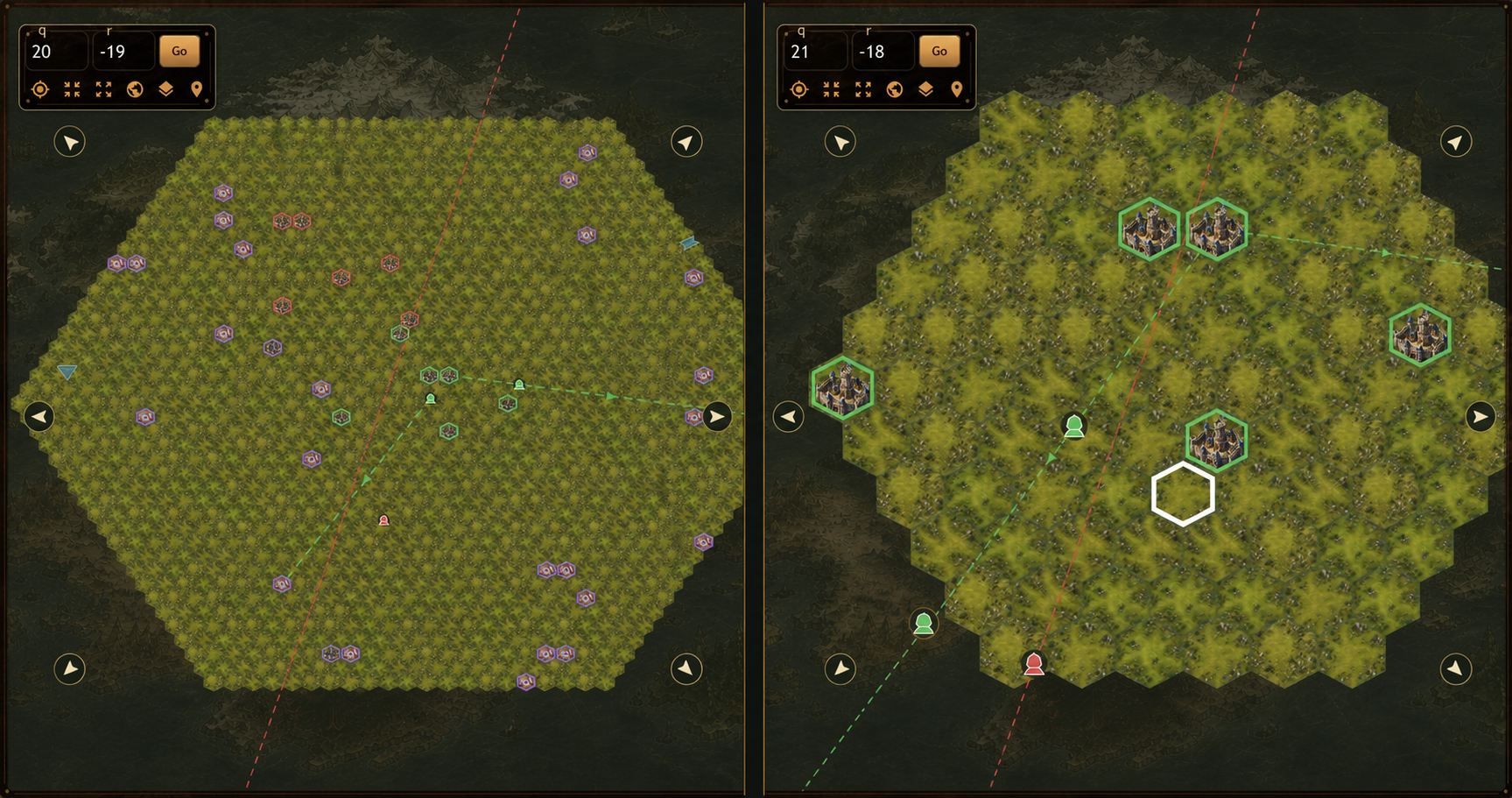
Green routes belong to your Heroes; red routes show movement from another civilization. Journeys remain visible across map scales.
A Hero moving toward the same area as one of your Rumors may be a coincidence.
Or it may mean that somebody else knows more than you do.
Players can watch where their neighbors are travelling, estimate whether an opportunity is becoming contested, and decide whether to send a faster Hero, investigate another lead, or look elsewhere. The return journey appears as a new movement leg, and the Hero disappears from the map after reaching Home rather than becoming a permanently deployed unit.
The continent is therefore not only populated by static Lands. It is visibly active.
A Rumor Is Not the Truth
A temporary Event does not automatically reveal itself to every civilization.
Instead, the world produces a public Rumor.
A Rumor is a time-bounded report anchored to a map coordinate. It suggests that something happened and identifies an apparent Event family, but it is not the Event itself and it is not verified Intel.
Its two central claims are independently uncertain:
- the reported location may be accurate or wrong;
- the reported family may be accurate or wrong.
The coordinates may lead to the right place while the interpretation is mistaken. The family may be correct while the marker points to the wrong cell. Both claims may be correct—or both may fail.
A report about a caravan in distress might really lead to travellers who need help—and Gold for the civilization that reaches them. Or the tale may have been misunderstood and point to something else entirely. A marker placed near an Event does not guarantee that the target is precisely there, that it remains available, or that another Hero has not already reached it.
A Rumor is information, not truth.
Rumors are public. Every player with access to Alef can see a current Rumor unless applicable Intel has replaced that uncertainty in their own view.
But knowledge is not synchronized automatically between civilizations.
If one player investigates a Rumor, other players do not instantly receive the result. If one player completes the underlying Event, everyone without Intel does not immediately learn what happened. They can continue to see the original public report until its ordinary expiration and may still send a Hero to investigate or respond to information that has become stale.
The Event belongs to the shared world.
What each civilization knows about it does not.
Reconnaissance—or a Leap of Faith
Every actionable Rumor creates a choice.
The player can spend time gathering reliable information, or act immediately and accept the risk.
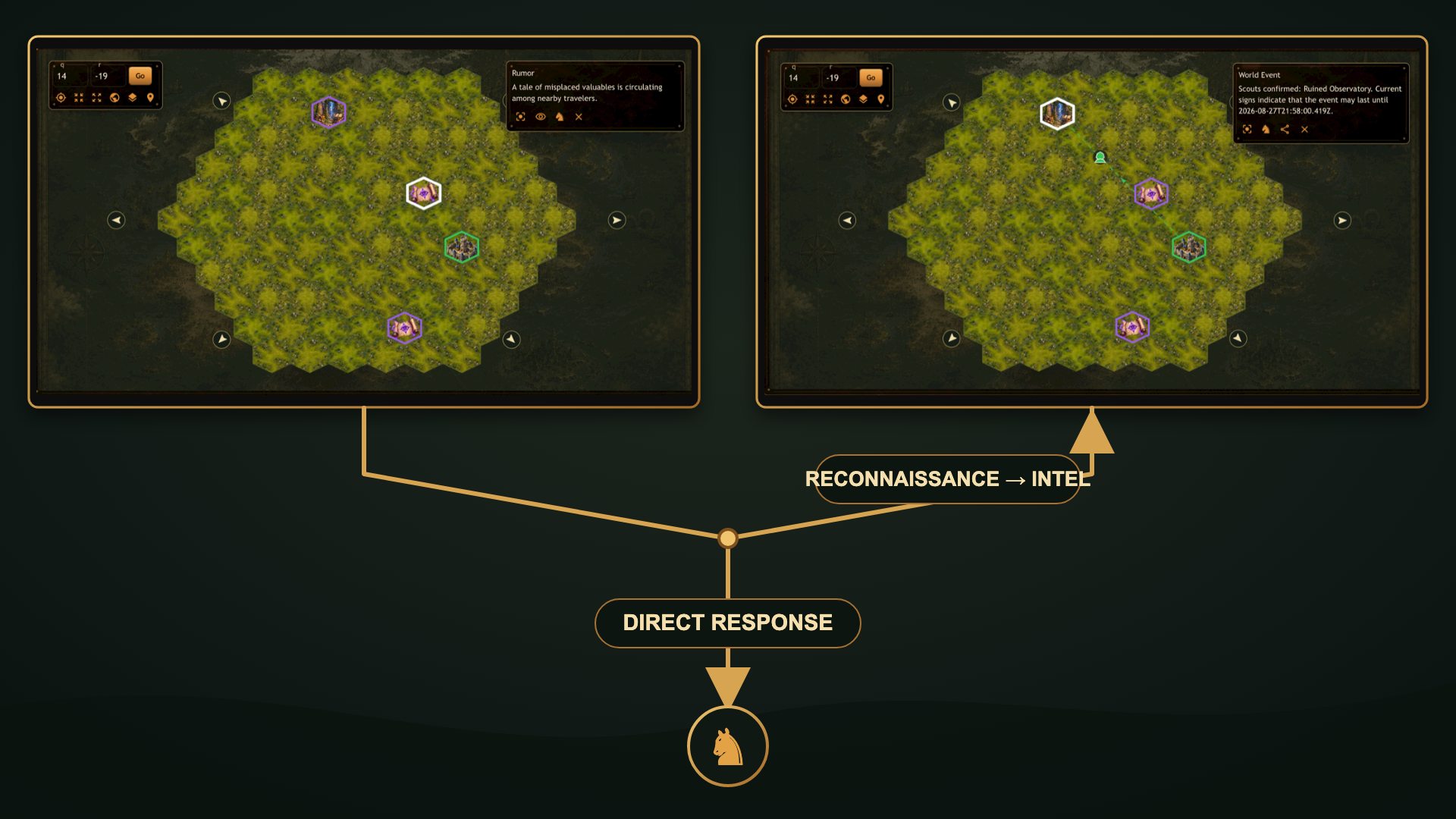
Investigate first and act on Intel, or send a Hero directly and accept the uncertainty.
Neither answer is always correct.
Reconnaissance
Reconnaissance is a Hero-led Mission dedicated to knowledge.
The player selects a visible Rumor and an eligible Hero who is idle, belongs to the Profile, and has a Residence on a Land on the same continent. The Hero leaves that Home Land, travels to the reported coordinate, investigates the area, and returns to the same Home.
Travel and investigation are separate parts of the Mission.
Each travel leg depends on map distance and the Hero's regular movement speed. Agility contributes to that derived speed. The field investigation has a base work duration, while the Hero's Intelligence performance and applicable Mission-duration effects determine how long that work takes.
Reconnaissance is not free. Even the most self-respecting scout needs travelling expenses. The items required for the expedition are reserved when the Mission is launched.
The benefit is not a conventional reward drop. It is a better understanding of the world.
A completed investigation can:
- confirm the actual Event behind the selected Rumor;
- reveal its true coordinate, objective family, and concrete type;
- record that the Event has already been completed, cancelled, or expired;
- discover other current unknown Events in the surrounding area;
- create Profile Intel that becomes usable even while the Hero is returning.
Reconnaissance never captures, completes, cancels, or rewards the Event. Its purpose is information. It can tell the player which Response Mission is actually appropriate, where the Event really is, and whether sending another Hero still makes sense.
This knowledge has a cost beyond Gold and Lucky Coins: time.
While the scout travels and investigates, another civilization may respond directly and reach the Event first. Intel makes a later decision better informed, but it does not preserve the opportunity.
Direct Response
The player can also act on the Rumor immediately.
A direct Response Mission travels to the reported coordinate and uses the reported family to select the Mission. The Hero is still bound to the exact Event that produced that Rumor; the Mission cannot silently substitute another Event that happens to be in the same cell.
This path sacrifices certainty for speed.
If the Rumor's location and family are correct and the Event remains available, the Hero can capture it on arrival and begin the work. If another Mission already holds the Event or it is no longer current, the Hero returns without spending the reserved Mission ingredients.
False information is different.
If the coordinate is wrong, or the coordinate is correct but the reported family is false, the expedition spends the reserved Mission ingredients and returns without field work, reward, ordinary progression, or a family result. The Profile records that the Rumor was checked, preventing the same player from repeatedly following the failed report without revealing the hidden truth behind it.
The strategic exchange is simple:
Reconnaissance buys knowledge with time.
Direct Response trades certainty for speed.
Four Families of Missions
Stage 1 introduces four Response Mission families. Each one represents a different kind of opportunity, rewards a different Hero specialization, and has its own base work duration after the Hero reaches the destination. The relevant Performance Skill and applicable Mission-duration effects determine how long that work takes.
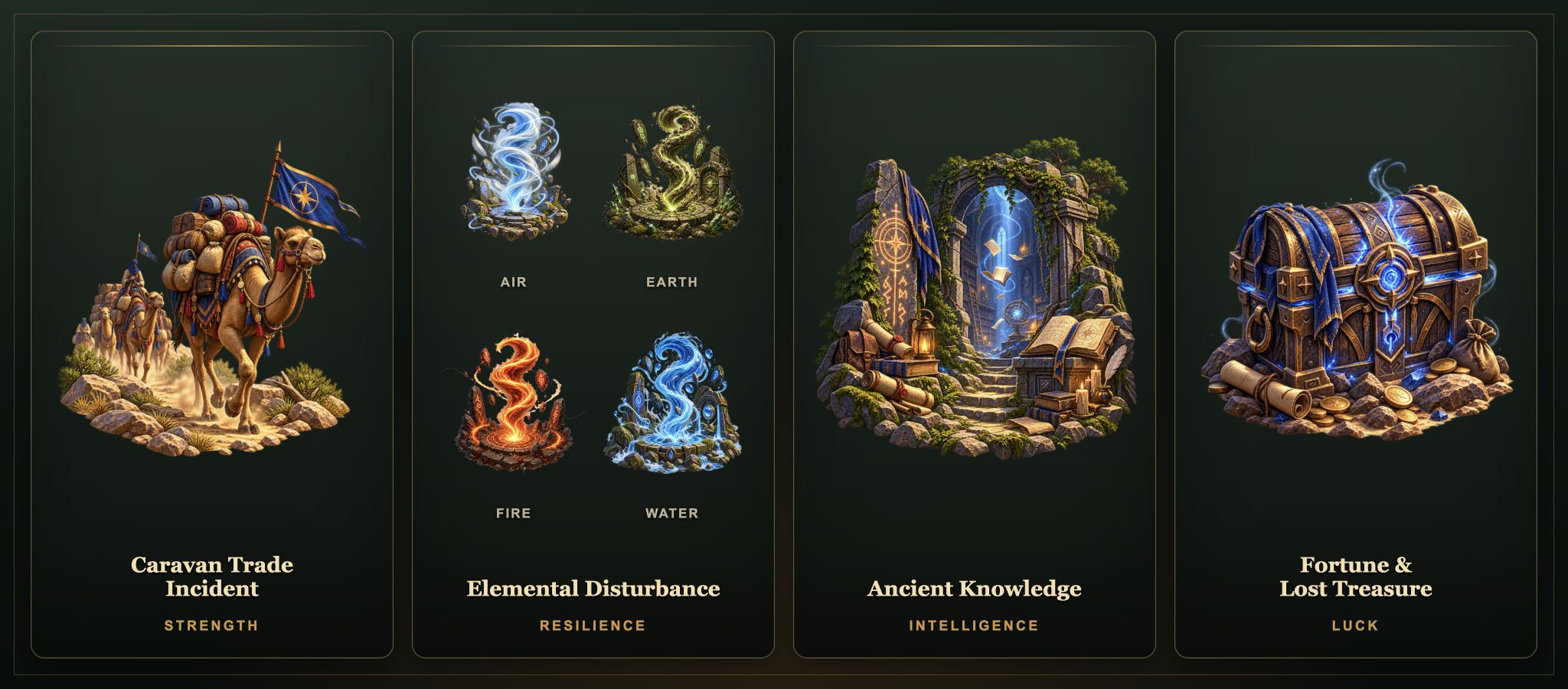
Seven World Event images form four Mission families. Elemental Disturbance can appear as Air, Earth, Fire, or Water.
Every Response Mission requires its own Mission ingredients, reserved when the expedition begins. Travel time is added in both directions.
| Mission family | Performance Skill | Successful result |
|---|---|---|
| Caravan Trade Incident | Strength | a meaningful amount of Gold |
| Elemental Disturbance | Resilience | a substantial amount of matching Elementals, limited by Hero control and available Vessel capacity |
| Ancient Knowledge | Intelligence | a valuable bundle of Uncommon Hero XP Scrolls |
| Fortune & Lost Treasure | Luck | an exciting haul of Lucky Coins |
Gold and Lucky Coins return to the Profile Treasury. Hero XP Scrolls return to the Home Land. Elementals return to the matching Vessel on that Land, where ordinary leakage and available capacity still apply. Elementals beyond what the Vessel can accept disperse rather than becoming a separate item balance.
The common journey is:
Home Land → Outbound Travel → Arrival → Mission Work → Return Travel → Settlement
The best Hero is therefore not determined by one number.
A Hero's regular speed affects both journeys. The Mission's Performance Skill affects the work at the destination. The Home Land determines where the expedition begins and where its result must return. Distance influences whether a Hero can reach a contested opportunity before someone else.
The new question is not only:
Who is the strongest Hero for this Mission?
It is also:
Who can actually get there in time?
Knowledge Changes the Map
Rumor and Intel are not two levels of the same marker. They are different representations of what a civilization knows.
Before investigation, the player sees a Rumor at its reported coordinate. After applicable positive Intel becomes available, that Rumor is hidden in the player's map view and the current World Event appears at its actual coordinate with a safe description.
Other players without that Intel continue to see the Rumor.
If investigation finds that the Event is already gone, the player receives safe negative Intel instead. The Rumor is hidden for that Profile because the civilization now knows that nothing remains, even though the public report can still be visible to everyone else.
Intel can apply to:
- one Profile;
- the current members of a Guild;
- eligible Profiles on the Event's continent.
Several audiences can therefore understand the same Event differently. One player may have precise personal Intel, a Guild may share broader knowledge, and another player may still have only the public Rumor.
The geography is known.
The state of the world is not.
Intelligence Can Be Shared
Intel does not spread automatically, but it can be shared deliberately.
A current known Event can be sent through an eligible in-game chat. The shared message carries structured Intel rather than relying only on copied text. A recipient can use its Go action to open the relevant Local Map area, while the map still applies the recipient's current authorization and Event visibility.
The chat audience determines the destination of the knowledge. Intel can support coordination with another Profile, with the current Guild, or with eligible players on the same continent through the corresponding channel context.
Sharing creates knowledge for the receiving audience. It does not reserve the Event, stop its timer, reveal a guaranteed reward, or ensure that the opportunity will remain available until another Hero arrives.
That distinction matters.
One player may invest Hero time in Reconnaissance. Another may contribute the right Hero for the Response. A Guild can coordinate around knowledge that none of its other members gathered personally. A player can warn others about a distant opportunity without changing the Event itself.
Rumors attract attention.
Reconnaissance creates knowledge.
Sharing turns knowledge into coordination.
This Is Only the First Stage of Epoch Two
The World Map and exploration loop form a complete playable stage, but they are not the whole of Roads of Prosperity.
Epoch 2 is designed to develop through four cumulative stages. Each later stage builds on the geography, travel, storage context, Hero activity, and shared knowledge established before it.
Stage 1 opens the roads; later stages will give civilizations more to find, produce, and exchange across them.
Stage 2 — Warehouses and Material Search
The next stage gives exploration a material outcome.
Lands will be able to develop Warehouses for four basic materials: Food, Wood, Stone, and Iron. Material Rumors and Search for Materials Missions will let Heroes recover supplies from temporary opportunities in the world and return them to the Warehouse of their Home Land.
Reconnaissance will remain a knowledge Mission rather than becoming an automatic resource collector. Players will still decide whether to investigate a material lead first or send a Hero to search directly.
Stage 3 — Production and Land Economy
The third stage turns Lands into continuous economic centers.
Farms, Lumber Mills, Quarries, and Iron Mines will produce the four basic materials. Living Quarters and workers will create a new settlement layer, while allocation and specialization will let different Lands develop different economic roles.
Produced resources will not simply teleport into storage. Heroes will collect them from production buildings and deliver them to the Land's Warehouse, preserving the principle that players act upon the world through their Heroes.
Stage 4 — Trade Routes
The fourth stage connects those economic centers.
Caravan Depots, trade routes, direct deliveries, and resource exchange will make origin, destination, distance, cargo, and visible movement part of regional trade. Caravans will use the same map rather than creating a separate economy detached from geography.
These later stages will add purpose to the positions established today.
The map gives every Land a place in the world.
The economy will give that place a purpose.
From Personal Growth to a Shared World
Epoch One was about developing Lands and Heroes.
Epoch Two places that civilization in a shared world.
Now distance matters. Location matters. Information matters. A Rumor can attract several players, but each of them may understand it differently. Heroes crossing the continent become visible signs of intent. One player can act on an opportunity, another can investigate it, and a third can receive the resulting Intel through cooperation.
Influence begins before borders and conquest.
It begins when a civilization becomes present: when its Lands occupy real places, when its Heroes travel across visible routes, when its decisions change opportunities for others, and when its knowledge helps shape what other players do next.
The world has always existed in War of Continents.
Now players can finally step into it.